In April of 2017 it was my turn to select a text for my book club to read
and discuss, and I chose Alexander Pushkin’s Eugene Onegin. It was not my first choice; that would have been
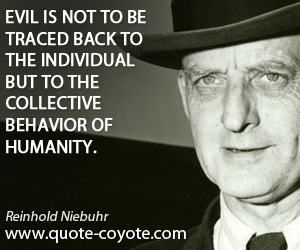
Reinhold Niebuhr’s Moral Man and Immoral
Society. But after suggesting it to others in the group, it appeared that
there was little enthusiasm to read a philosophically dense treatise, and so I
de-selected it, as it were. I nonetheless decided to read Niebuhr’s book, in
part because I have a taste for philosophy but also because one of my students
recommended it. The investment of time it took to get through Moral Man and Immoral Society was worth
it, for, as often happens after reading great literature, Niebuhr’s analysis
forced me to examine my own assumptions and beliefs, and even to re-evaluate
them.
Although Moral Man and Immoral Society is a
philosophically profound text, the main thesis is rather simple: we need to
draw a clear distinction between the moral behaviour of individuals and of
groups. Individuals are capable of genuine love, the kind that allows an
altruistic transcendence of one’s own interests. Groups, on the other
hand—class, race, and national in particular—are intrinsically selfish in the
sense that they are incapable of being truly altruistic. The relations between
groups, therefore, must always be
primarily political rather than ethical and will be determined by the relative
power that each group possesses. The significance of this thesis should not be
underestimated; it poses an existential challenge to belief systems, including
Christianity, liberalism, Marxism, and humanitarianism, that assert the
existence of a universal morality that can transcend the moral defects at
the heart of all inter-group behaviour.
If Niebuhr’s purpose is to dismantle the universalist
pretensions of those camps, one may suspect that he concludes we are left only
with an amoral political realism based on the inevitability of the naked
struggle for power. But that would be a misreading of the book; as this
blogpost will show, no philosophy, not even realism, is spared from the light
of Niebuhr’s immense intellectual acuity. The defects of realism will be
addressed at the end of this post, but first it is essential to elaborate on
Niebuhr’s main thesis.

Tragedy and Inequality
A tragedy of life is the existence of various forms of inequality,
especially in our political and economic relations. Justice, then, entails
moves towards equality, and not coincidently, most theories of justice, whether
secular or religious, aim to achieve more equitable social relations. Reaching
that objective depends on social action but it also requires a change in human
consciousness, subjectivity, and feeling so that love and altruism replace
interest and egoism. Given the right circumstances, this change is possible
among individuals in the interpersonal realm of life, mainly because humans are
capable of genuinely loving those close to them. We can clearly identify their
needs, weaknesses, and wants, and can relate to them without any calculation of
personal loss or gain. Complete mutuality, understood as the entanglement and
enmeshment of interests, is possible in the interpersonal realm and, therefore,
so is complete equality and justice. Relationships between groups—class, race,
national—do not share these properties and potentialities. Groups are abstractions
that can inspire loyalty but not genuine love. This becomes the basis of group
power in relation to other groups, transmuting in-group devotion into out-group
competition. Therefore, whenever humans organize themselves into groups that
depend on loyalty, inter-group behaviour will be based on interests, egoism,
and relations of power. The implications for the unjust inequalities between groups are significant. If
purely ethical behaviour between them is not possible, inter-group injustice
can only be addressed via struggle and strife that helps to equalize these
relations in some way. However, although these struggles may be successful in
the sense that they may strengthen the weaker group and weaken the stronger,
perfect equality between groups will never be fully obtained or durable. The
persistent inequalities between groups sow the seeds, or set the stage, for the
next round of struggle and strife ad
infinitum.
But Liberals are so nice!
Enlightenment thinkers, and those inspired by them, would disagree. One
of the key planks of this intellectual movement was that universal justice is
possible. To achieve it, religion, superstition, and hereditary privilege would
need to be replaced with commerce, democracy, secularism, and the rights of
man. The primacy of reason, imparted through universal education, would
inexorably help man discard his ancient delusions and guide him towards the
utopia of an order based on relationships of liberty and equality among all
persons.
Niebuhr shows how implausible this is. He demonstrates that liberal
society contains much hierarchy, inequality, and coercion that produces an
unequal distribution of power and privilege among myriad groups living in the
same political unit. One example he
cites is universal publicly provided education, which is one of the main
mechanisms today’s descendants of the Enlightenment (progressive liberals)
believe will produce the change in consciousness that leads to universal
justice. It depends on the coercive apparatus of the state, and the state is
hardly impartial. Rather it is dominated by privileged groups who, with their
political and economic resources, arrogate themselves the power to decide what
should be taught, and how. The immense privilege this confers is mainly
recognized by those who are excluded from these structures of power. In
contrast, the privileged classes are largely oblivious to their power mainly
because of the tendency of powerful groups to equate their interests and values
with everyone else’s. Inequality is reproduced, in part, by the acquiescence of
the weaker party to this state of affairs even though they recognize that
inequality and coercion lies at the heart of it. But this consent is not
durable; when the weaker and excluded group begins to increase its relative
power (either in numbers or economic resources), it will challenge the stronger
and privileged class. The logic of this analysis is applicable to other areas
of inter-group life, especially race relations. Niebuhr vividly illustrates how
whites, not only are they often
oblivious to their power over blacks, but they also equate their values with
those of the community. As the dominant group, they have an outsized influence
on the coercive apparatus of the state, ensuring that institutions are never
really impartial. Rather, institutions rely on coercion that reproduces
inequality, political and economic. It is the oppressed races that see the
state of affairs clearly, Niebuhr argues, for they do not suffer from the
ideological delusions that afflict the powerful.
In the international sphere, the main collective unit is the nation,
which perhaps suffers most from the moral defects that affect all groups. Scoundrels
use this political unit to vicariously enhance their own sense of prestige.
Their belongingness to the nation provides a sense of equality and dignity that
are unattainable in other realms of life, inspiring a degree of loyalty that
makes them willing tools of the powerful members who execute all the abusive
policies associated with powerful nations, in particular imperialism in its
various guises. Meanwhile, the powerful always cloak the expansionary or
imperial policy of the nation in the language of universal values, confirming
the pattern that can be observed in the domestic realm whereby economically and
politically dominant groups conflate their interests with the community’s.
Powerful states are expansionary because the preservation of their power
depends on continued increases in strength in relation to their rivals,
highlighting the very thin, perhaps non-existent, line between defensive and
offensive capabilities.
Niebuhr wrote this text in 1934, when, among other things, the British
Empire still commanded large swaths of the world. He is therefore unforgiving
in his dismantling of the pretentions of British imperialists who conflated
their colonization with universal values. Niebuhr does not spare his home
country, America, either. It too engaged in imperial policy when it defeated
the Spanish and took their territories in Cuba and the Philippines. And it,
too, defended this naked imperial policy with the language of universal values
and civilization. Niebuhr says this pattern occurs because statesmen are trying to
resolve the unbridgeable gap between the ethical categories that influence
their interpersonal relations with the naked struggle for power that exists at
the inter-group level. Rather than honestly interrogating this gap, they engage
in self-deception and hypocrisy.
The worst kind of self-deception and hypocrisy is observable among so
called “humanitarians.” During the Spanish American war, it was the
humanitarians who, in Niebuhr’s colorful phrase, went into a frenzy of
“ecstasy” in support of the war in order to “liberate” oppressed Cubans and
Filipinos. The moral defects which afflict all groups perhaps reach their
climax among humanitarians because their sense of righteousness impedes the
capacity for critical thought. It is not hard to imagine what Niebuhr would
have thought of today’s “humanitarians” (known as neocons and liberal
interventionists). He would have seen their attempt to frame political
ambitions in the language of universal justice and morality for what it is: a
combination of righteousness, hypocrisy, and self-deception.
The humanitarian disaster in Syria is a case study that reveals the
continued utility of Niebuhr’s thesis more than 80 years after it was
published. Especially in the West, there are loud and influential voices
calling for American intervention to destroy the government of Bashir Al-Assad.
Almost invariably, this policy is framed in the language of universal
values—for example, the need to promote human rights and democracy. Niebuhr’s
thesis encourages us to look beneath the language of universal values used by
the powerful; what might we find? First, we would notice that the attempt to
frame the conflict in terms of some clear moral dichotomy, with the evil
fascist dictator on one side and a group of innocent, democratic, and oppressed
rebels on the other, as meretricious and tendentious. Rather, there are
different groups which are struggling for power, and each is trying to gain an
advantage relative to their rivals. The dictator, for example, is Allawi and is
supported by secularists, Christians, Druze, Kurds, and other minorities. The
rebels, meanwhile, are almost exclusively Sunni Muslim and largely Islamist.
Geopolitical associations matter greatly too; the Islamist rebels are supported
mainly by Saudi Arabia, Qatar, UAE, Bahrain, America, Israel, Britain and
France, while Assad is supported by Iran, Egypt, and Russia. These inter-group
struggles lie at the heart of the conflict, and all the parties are motivated
by power; it follows that intervention must favour one or the other groups in
their egotistical struggle for domination. Thus, channeling the spirit of
Niebuhr, we’d say that the attempt to frame this inter-group struggle in the
language of universal values is a best naïve and at worst dishonest.
Faith in Marxism?
Marxism is not spared from Niebuhr’s analysis. When Moral Man and Immoral Society was published, the Cold War was not
yet in full force but Marxism had prevailed in Russia and had gained many
adherents in the West. Communist intellectuals, as children of the
Enlightenment, believed that the universal morality of communism would produce
universal peace and justice. First, however, capitalism had to be dismantled,
because it was the economic inequality produced by capitalism that was
responsible for myriad social and political ills. Once private property was
eliminated, there would be a transition phase, and then the eventual
achievement of a society, and a world, organized around the principle of “to each
according to his needs, from each according to his abilities”. Presumably, the
pathologies that characterize inter-group behaviour, including imperialism and
colonization, would be abolished too. Niebuhr begins his critique of Marxism by
pointing out the obvious, namely, that imperialism existed long before
capitalism and will exist after it. He adds that the application of Marxism,
although inspired by good intentions, creates a new inequality on the ashes of
the old one. Political class replaces economic class as the primary determinant
of power and privilege, and powerful groups inevitably become egocentric,
reproducing the inequality between themselves and the excluded. Politically dominant groups in Marxist
societies, unsurprisingly, also frame their power and privilege in the language
of universal values and justice, confirming the pattern of self-deception and
hypocrisy seen among other groups.
We now turn to another religion, specifically Christianity. Building on the observations of Nietzsche, Niebuhr accurately observes that Christianity was a “slave revolt” because, in contrast to the ethics of
antiquity which celebrated strength and
superiority, this new religion claimed that the meek, not the strong, would
inherit the earth. Marxism’s vision is not that different: it too claims that
the weak (i.e. the working class) are destined to prevail. Whereas Christians
believe that the Holy Spirit will ultimately lead to the promised land,
Marxists believe in the mythical power of “historical materialism” to actualize
the inevitable utopia. And once utopia is reached, universal justice will be
achieved, and humanity will transcend the moral defects of all groups, and
especially the powerful.
Niebuhr is unforgiving in his critique of Christianity even though he
was a devout believer and a theologian by training. He points out what every
student of history knows, namely, that once Christianity obtained power, it
displayed the tendencies of other powerful groups, including the desire for political
expansion and the framing of this action in the language of universal values
and justice. He critiques the faith on other grounds. Contra Christianity, violence is not intrinsically immoral, and can
be justified if the purpose is to fight oppression. To support his case,
Niebuhr cites three instances of oppressed groups which took a purely Christian
approach to fighting oppression: (pre-civil rights era) blacks in America,
peasants in Russia fighting Czarist autocracy, and socialists in Italy who
attempted to fight the Fascists in their country. In all three cases, efforts
to fight the oppressor with love and non-violence ended in failure. Only
struggle and strife could help to successfully challenge the powerful.
The hole in the heart of realism
This leaves us with political realism. The need for order requires
power, and the establishment of power always entails economically and politically
dominant groups using coercion to impose their vision on others. This entails
inequality of some kind—economic or political, which becomes the basis of
future struggle, as soon as the weaker group possesses sufficient power to
challenge the more powerful group. Genuine equality between groups is therefore
never durable, and hence neither is universal justice. We are therefore left
with eternal struggle and strife, which would be a very bleak conclusion.
But Niebuhr shows that it is not so simple. Although political realism
is the most rational political theory in the sense that it is devoid of
illusions and ideals, pure rationality can be just as dangerous as idealistic
moralism. Niebuhr shows how rationality is never really impartial, and in fact
it most often expresses the interests of the group in which one belongs. Members
of powerful groups are therefore apt to use their reason for the perpetuation
of privilege, and hence their ideas cannot be taken at face value, especially
by members of weaker groups who see through the ideological justifications of
their masters.
Idealism may be necessary even if it is based on illusion, and herein
lies the paradox of progressive social action. According to Niebuhr, the vision
of perfect justice is impossible but it
can only be approximated by those who do not regard it as impossible. In
Niebuhr’s poignant words, “the most important illusion is that perfect justice
is achievable, for it cannot be approximated if the hope of its perfect
realization does not generate a sublime madness of the soul”. The absolutist
and fanatic, although dangerous, is necessary because society is inclined to
inertia. Religious madness is particularly suited to the task of approximating
justice because it is often “purer” than the secular kind, and this purity is
essential to its efficacy. Again, in Niebuhr’s own words:
The highest
mutuality is achieved where mutual advantages are not constantly sought as the
fruit of love. For love is purest when it desires no returns. Mutuality is
therefore most perfectly realized where it is not intended; that is how the
madness of religious morality becomes the wisdom which achieves wholesome
social consequences.
Within the group, the madness of religion may approximate justice, but
not it cannot overcome the egoism that lies at the heart of all inter-group
behaviour. Relationships between groups will always display some form of
inequality, political or economic, and this ensures that competition, struggle
and strife will eternally characterize inter-group relationships. Moralists,
activists, and ideologues will not take kindly to Niebuhr’s conclusions, but if
they are intellectually honest they may recognize that he encourages them,
especially if they are members of dominate nations, to shed the language of
universal justice and reveal the egotistical political ambitions that lie at
the heart of group activity. Members of weaker groups will find much that is
inspiring in Niebuhr’s work, for it helps to unmask the universalist
pretentions of stronger groups. On the other hand, he reminds weaker groups
that they cannot escape the moral dilemmas he recognizes as intrinsic to all
collective units, whether class, race, or nation. They may, via struggles
against stronger groups, reduce inter-group inequality, and they may even
become more powerful than their erstwhile foes. When that occurs, their
intrinsic egoism will be deployed to preserve the privilege and power they have
accrued, at the expense of groups who have less power and who will eventually
challenge them, leading to another round of struggle and strife ad infinitum.