Tuesday, July 25, 2023

Review of Mary Beard's SPQR

In 2023, I continued my practice of taking the extra time afforded by the summer break to read on the subject I have an enduring fascination with, ancient Rome. This interest developed in large part because of my regular travels to visit family in Italy since I was a kid, where I would often go to ancient Greek and Roman sites—some relatively well preserved—located close to my ancestral village in the province of Salerno (notably, Pompei and Paestum). The text selected for the summer of 2023 was Mary Beard’s SPQR: The History of Ancient Rome. It is a work of general history, and its chief value is that it brings to life many of the social dimensions that are neglected when, as is often the case, the discussion centers around the lives of emperors and their conquests. There are two elements I will focus on in this blogpost: the relative openness of Roman culture and citizenship, which distinguished it from other ancient civilizations, and the rise of inequality and corruption which was partly generated by this very openness—the increased wealth derived from incorporation of large swaths of territory and vast numbers of people, over time, became concentrated in fewer and fewer hands. 

The latter is related to my scholarly interests on the phenomenon of populism, which often represents a lower class uprising against the elites who benefit from expansion and openness to trade. As we will see, the fact that this pattern can be observed during antiquity, in a civilization dramatically different from our own, and in the present, highlights the recurring and structural character of certain political patterns: the geographical and economic expansion of great powers, followed by the unequal distribution of gains, and the resulting political opposition from those who do not benefit, or are disadvantaged, by the system.

Empire without End

Rome’s openness can be traced to its very beginnings, in 753 B.C. According to the mythology of the nation’s origins, it was founded by foreigners escaping hostile lands in the East (here we see echoes of America’s original settlers), and when Rome’s founding fathers, the brothers Romulo and Remo, announced the new polity, they welcomed rejects, refugees, and reprobates from other parts of the Italic peninsula (more echoes of America here, as displayed on the Statue of Liberty: “give me your tired, your poor…masses yearning to breathe free…the wretched refuse of your teeming shore”). Unlike in America, however, the polity was initially a traditional monarchy. It transitioned to the republican system of government in part because of the corruption of the king Lucius Tarquinius “the Arrogant.” The general assembly voted to replace the office of the king with that of the consoles—who had many of the same powers but were elected to serve 1 year terms. Now, power was divided between the Senate, composed of members of the aristocracy, and the consoles, elected directly by the people. The Senate and the People were Rome’s constituting elements, hence the appellation Senatus Populus Que(is) Rome, or SPQR, and title of the book under review. 

Consoles were magistrates who often came from the privileged classes, but they eagerly courted voters, giving the latter sway in political outcomes. Electoral campaigns in which candidates competed by making promises, replete with slogans displayed on busy streets, and tactics devised by professionals to increase the vote, were a regular feature. As recognized by the Greek writer Publius, the genius of this constitution was that it combined elements of democracy, aristocracy, and monarchy, leading to checks and balances which avoided excesses, created stability, emanating outwards and allowing Rome’s prodigious expansion, especially in the 2nd and 1st centuries B.C.

Another key feature was Rome’s conception of citizenship. It granted all the rights inscribed in Roman legislation, was gradually extended to vast numbers of people, and was a major instrument of social stability and power. Emblematic is the social war composed of disgruntled legionaries and slaves, in the early fist century B.C. Rome replied by granting citizenship to almost all inhabitants of the Italian peninsula. Stability was established by the decision to include them in the polity, rather than relying exclusively on military might. The highest expression of this policy occurred in 212 A.D., when the emperor Caracalla granted citizenship to the entire empire, which by then was vast: 65 million people, or 21% of the world’s population.  

One of the revolutionary aspects of this openness was that it separated citizenship from territory and blood relations. Unlike, say, in Athens, where citizenship was restricted to local inhabitants and their off-spring, who were believed to be connected to the land since time immemorial, Roman citizenship was an idea, or an identity, not organically tied to the city of Rome that could co-exist with local identities in a complimentary way; thus, for example, a citizen in a Roman province such as Egypt could consider himself Roman while speaking the local language (at the time, Greek), and practicing local customs. Along with other Roman technologies such as roads, aqueducts, and architecture, citizenship diffused Roman civilization around the Mediterranean and would set the stage for the entity we now call Europe and, eventually, the Americas.

Roman religion was also open, or, in the more contemporary verbiage, “inclusive.” There was no single religious book or document, or single god for that matter; there were multiple gods, and different ones were related to distinct peoples and/or their territories. For example, Jews believed in Jehovah, Egyptians in Isis, and Persians in Mithras, and few seemed to question the general idea that different people had different divinities. During Rome’s expansion, there was no attempt to extirpate local gods and impose those of the Romans. Subjects' and territories’ gods were incorporated into the empire’s pantheon. This occurred, in part, because for Romans, belief in gods was not connected to any concept of individual salvation or personal morality, nor was it that important as a theoretical question; rather, it was the social and practical functions of religion that mattered, such as participation in the sacred rituals and festivals which marked the calendar. (Here, we see echoes of the contemporary Catholic church, which not uncoincidentally has been key in preserving many aspects of the Roman legacy in the West).

This relative openness of citizenship and religion should not be conflated with liberalism as it is understood today. Rome, for example, was very militaristic, and this was manifest in culture, institutions, and practices. Romulo and Remo, the founding fathers, were believed to be offspring of Mars, the god of war. Democracy, understood as the right to vote, was granted to free (i.e. non-slave) males, in part because as soldiers they bore the brunt of Rome’s wars, and because wars often required majority approval. Women did not participate in the fighting at the time, which mostly relied on brute physical force and endurance rather than, as today, on technologies that have reduced the importance of face-to-face combat. Other conditions militated against more female participation: in a world without contraception, and where up to half of children died before their 10th birthday, the estimated birthrate, just to preserve the stability of the population, was 5-6 children per woman. Only the wealthy—a small minority—had slaves and servants to help with child-rearing and household labour.

There was never a clear separation of the military and the civil polity, and Roman generals made decisions on civil matters. The path to glory was success on the battlefield, and emperors sometimes participated in the wars they waged. Literature which suffused Roman society, like Virgil’s Aeneid, exalted the virtues of self-sacrifice in the pursuit of military success and territorial conquest. This book was widely read and studied and, according to Mary Beard’s SPQR, represented a cultural reference point which was shared among the Roman elite and the masses. Entertainment for Romans of all social classes included gladiatorial fighting between humans, and between humans and animals, to the death. There was no organized police force, and so many had to rely on themselves, or the powerful men of the families, for personal security; when they were insufficient, they relied on vigilantes, who of course were led by brutish men. 

Although relatively open by the standards of other ancient civilizations, legal equality did not exist. The major groups were the plebs (in today’s terms, the “people” or the “masses”), the patricians (or the wealthy) and slaves; the last were mostly European in origin (unlike the race-based slavery of the modern period). Greeks, for example, were valued as slaves because of their literacy, and often served as secretaries and other roles which involved mental work such as accountancy, letter-writing, or proof editing drafts of texts to be published by their owners; Germans were also highly represented among slaves in part because of Rome’s constant fighting on its northern frontier, and captured Germans were often brought back to Rome as slaves suited for physical labour. However, unlike in ancient Greece, where slaves had little chance to escape their plight, Roman slaves often became freemen and Roman citizens, because they could either buy their freedom, or the owner could grant it; some evidence suggests that up to half of slaves were freed this way.  Overtime, this contributed to Rome’s unique ethnic diversity and mixing (and which is still visible among the peoples of the Mediterranean).

Major conquests occurred from the third to the first centuries B.C. The entire Italian peninsula was subdued with the defeat of the Etruscans ad Sannites by 275 BC. Later, the famous Punic wars against Hannibal, and the eventual destruction of Carthage, gave Rome possession of Spain and North Africa, while Greece was conquered shortly after, in 168 B.C. Caesar conquered Gaul (modern day France) in 50 BC,  and Pompey consolidated Roman rule in Judea and Syria (Asia) during the same period. Egypt became a Roman possession after Octavius’s victory in the civil wars.  

The increase in territory and population led to an increase in the various sources of wealth. Not only the expropriation of natural resources (precious metals, building materials, grains), but also tribute from locals in either direct taxation, or in soldiers for the Roman army, and expanded commercial opportunities, especially luxury goods from the east. Much of this new wealth financed public projects, such as the still-astounding Colosseum and the timeless Pantheon, which transformed the capital city, giving it its majestic character which continues to dazzle millions of tourists every year. Privileged groups, often through corrupt dealings with authorities in the Senate and in the provinces, had better access to the wealth derived from the newly incorporated territories and peoples. The aristocracy used this wealth to build ever more palatial abodes (many still well preserved), and to purchase and consume more imported luxuries from the east. Meanwhile, many of the inhabitants of the city lived in squalor, or what today we would call shanty towns. Here, Rome was distancing itself from the martial and inclusive ideals of its founders, and from the Republican institutions which were supposed to give voice to the plebs. Many among the masses had fought in Rome’s wars and contributed to the empire’s expansion, only to return to their homes in the Italian peninsula without jobs, land, or the capacity to live a dignified life.

The Gracchus Brothers: Ancient Populists


This led to a feeling of betrayal among many Roman citizens and laid the groundwork for candidates to office who promised justice. In Mary Beard’s SPQR, two are extensively assessed: Tiberius and Gaius Gracchus, brothers and war heroes in the wars against Carthage who were outraged by the conditions of the plebs, especially those who had served Rome. Their lives were extensively documented and hence we possess a considerable amount of information about them. Both would be considered “populists” in today’s political lexicon. Their enemies were mostly the aristocratic interests defended by Senators (or, in the language of contemporary populists, the “corrupt elite”). Of the two, Gaius was perhaps the most radical, and proposed reforms to benefit the plebs  which included anti-corruption measures, restrictions on application of the death penalty, redistribution of fertile lands, and publicly funded and distributed grains (here we see echoes of many left-wing Latin American populists).  Other proposals included granting citizenship to greater numbers of inhabitants of the empire, which of course would increase the numbers who would be beneficiaries of the rights adumbrated above. This last proposal, in particular, highlights how the “people” were not understood in the exclusive and nationalist sense; rather, they included those without Roman citizenship but who were victims of exploitation, which was a violation of the norms upon which Rome was founded. 

Gaius won two elections as representative of the plebs, and out of the mentioned proposals, the distribution of grains remained for centuries, and as far as we know, did not have any equivalent elsewhere in the ancient world. The other elements of his agenda never saw the light of day, or were short lived, in part because Gaius was murdered by the aristocratic elements threatened by this populist program. 

This clash between Rome’s poor and the aristocracy was also evident in the more celebrated and known civil conflict in the 1st century B.C., that between Pompey and Caesar. Together with the wealthy Crassus, Caesar, and Pompey collectively ruled Rome via the office of the Triumvirate, but as ever, eventually had a falling out and this sparked civil conflict. The main contenders were Pompey and Caesar, and factions aligned with one or the other fought across the empire. Popular history has cast their conflict as a dispute about democracy and dictatorship, which culminated in the ides of March, when Caesar was stabbed to death in the Senate shortly after being declared dictator for life. Senators, it is widely believed, were defending the republic against a tyrant. Mary Beard’s SPQR highlights another dimension: Caesar was a quasi-populist, promoting reforms similar to those of the Gracchus brothers, such as the redistribution of lands, which threatened the interests of aristocracy, and it was partly for this reason that the available evidence suggests Caesar was loved by Rome’s masses. Pompey’s social base, meanwhile, was more represented among the privileged classes, and his death in Egypt heralded a victory of the Caesarian faction, an intolerable outcome which ultimately led to Caesar's assassination.

The republic, contrary to the pretensions of the perpetrators, was not restored after the assassination, and the civil conflict between the two factions continued. Now, it manifested as the conflict between Caesar’s adopted son, Octavius, and Mark Antony, who was seduced by one of Caesar’s former lovers, and mother of one of Caesar’s children, the Queen of Egypt Cleopatra. They initially shared power in the Triumvirate, but disputes about the empire’s spoils, and about who was Caesar’s legal heir, led to fighting. Octavius’s forces prevailed in the famous battle of Actium, and the humiliated Mark Anthony and Cleopatra fled and eventually committed suicide. 

Octavius became Rome’s first official emperor, now known to us as Augustus. Republican institutions still formally existed but they were emptied of substantive power; authority for most major decisions resided in the office of the emperor. Putting an end to the civil wars, and centralizing authority, however, established the conditions for stability and a new golden age. Augustus ruled for 50 years, and during that time invested heavily in public works, while trade expanded across the empire. Homogenization proceeded apace, but not because of a conscious policy similar to France’s missione civilatrice 17 centuries later. It was rather the movement of people, ideas—especially citizenship and education—and goods which helped to radiate Roman civilization across the its vast territories. 

As ever, this golden age was temporary, in part because many of Augustus’s successors—most notably, Nero, Caligula, Commodus—were either incompetent or meretricious. Increased wealth, and bad leadership, inevitably led to disputes about the distribution of the spoils. Meanwhile, Rome’s enemies gathered strength. This combination of internal division, and external threat from the now better organized and more numerous Germans, was ultimately fatal.

It was under these conditions that Christianity emerged on the scene. It was in one sense rather populist in that it challenged the "establishment" and elevated the moral purity of the poor and excluded. On the other hand, it did not participate in public life, and had beliefs which violated the Roman moral code. Partly for this reason, Christians were persecuted, as Romans viewed their beliefs as a threat to the moral order. SPQR cites the scholar Pliny the Elder to illuminate how authorities viewed this strange new sect. One element that was puzzling to the Romans was that the Christian deity was not organically tied to any territory or people; it was rather for all people and all time, which implied the utter rejection of all other gods. While Romans exalted the pleasures of this world and of the flesh, Christians viewed them as corrupting and an abomination and looked forward to the happiness of the next world. For this reason, Roman authorities went to great lengths to extinguish Christianity. Very few would have predicted what actually occurred: Christianity would become the official religion of the empire, spread across its territories and replace paganism, and eventually spread to all humanity when Europeans, almost 1500 years later, began to colonize the entire planet. 

This is one of the biggest social scientific puzzles of all time, and SPQR does not provide a definitive answer, but it does highlight that Rome’s expansion and openness were necessary conditions for the spread of Christianity. Roman trade, roads, currency, and institutions ensured frequent movements between the farthest parts of the empires, which at the extremes represented vast distances: from Hadrian’s wall in the West (modern day Northern England) to Syria in the East. Proselytizers from Judea, where Christianity was born, often travelled to the capital, and from there, ideas spread to other parts of the empire. And as the empire was falling apart in the 3rd and 4th centuries, where wealth and stability was replaced with foreign invasion, chaos, and poverty, Christianity’s profession of the evils of the world resonated more and more. 

Overtime, this led to revolutionary overturning of the moral order. A deeper and more extensive analysis of that will have to wait for a future blogpost, where I will review the work of the historian Tom Holland, who has extensively documented Christianity’s revolutionary impact, and the way it still manifests in secular guises on questions related to human rights, equality, and democracy. Before then, by the end of this summer, I’ll post a review of Edward Luttwak’s The Grand Strategy of the Roman Empire, which focuses more on foreign rather than domestic policy, and which I am presently reading.


Thursday, April 27, 2023

Initial Impressions of Shanghai

I arrived in Shanghai in mid-February 2023. In this blogpost, I will record my initial impressions of the city and its culture, while making some tenuous connections to the experience of living and working in China.

Many Americans, British, Italians, Germans, Russians, and other Western expats live and work in Shanghai, and some have settled semi-permanently. A profile of the typical expat is that they are either a teacher/professor (like me), or in business, between 30 and 50 years old, and as befits the city they live in, very cosmopolitan. They organize many activities, such as book clubs, art and philosophy discussions, or talks on contemporary and topical matters. I was invited to give a talk at one of the these events on the subject of populism, which I did, and about 45 people attended—mostly expats but also Westernized locals. 

Participating in these activities has been a goldmine of intellectual growth and social enrichment for several reasons. First is that often, the subject is China, allowing me to deepen my knowledge about this ancient, complex, and fascinating civilization. Many of the participants in the mentioned events are Chinese, while others are foreigners and, unlike me, have lived here for a long time, speak the language fluently, and some have deeply assimilated via marriage and family; this gives them unique perspectives and insights. Second is that I have been able to connect with like-minded individuals and have a semi-social life in the city. After a long day of work, participating in one of the events organized by the expat community in Shanghai provides highly valued meaningful connection and conversation.

In other non-English speaking cities I have lived in—in Paris and Madrid, for example—I have almost always connected with locals rather than expats, in part because, by the time I arrived, I had basic or inter-mediate conversational ability in the local languages (I have recounted those experiences here and here). And I now have a good level of French and Spanish in no small part because of the intense learning accrued during periods of full immersion in France and Spain. This time it’s a little different mainly because when I arrived, I knew very little Mandarin. I started learning the language on an app very recently, and by February of this year I could communicate some simple sentences, while my listening skills were basically zero. I have continued to learn the language using the same app and taking weekly classes at the university, and although progress is slow, it is easily one of the most fascinating and enjoyable aspects about living in Shanghai. I can now communicate the essentials, for example, when shopping, and each advance, however little, is gratifying. I hope to obtain conversational capacity in a year, and perhaps by then, I will be able to participate in local activities in Mandarin rather than in English. At that point, a deeper assimilation will be possible. 

One unexpected discovery is how technologically advanced Shanghai is, particularly its transport, communication, and financial infrastructure. I take the metro and train frequently, and both are hyper-modern, very clean, always on time, very cheap and relatively easy to use. For example, a return ticket from Shanghai to Suzhou—a distance of about 80 kilometers—on a high-speed train that travels at almost 300 kilometers per hour costs the equivalent of about 8 euros. Travelling the same distance in Europe on a high-speed train would cost double or triple that. Meanwhile, a single trip on the metro is equivalent to less than a dollar—here, the cost is similar in European cities, but not in Toronto, where one trip costs more than 3 dollars. 

The high-speed trains I frequently use are marvels of human engineering that are so integrated into the city’s quotidian fabric, that they have become banal to locals. I have a vivid memory which illustrates this. One early morning I was on the train to Suzhou. As it arrived, I and other passengers got up and formed a queue and waited to get off. We started moving towards exiting the train, and as I approached the exit looking straight ahead, in front was the outline of the train’s sliding door, which divided the interior of the train, with its white walls and artificial light, and outside the train, where the soft rays of the morning sun were reflecting on the surfaces of the platform’s shiny grey marble floors. At that moment, on the other side of the platform, directly in front of me, another train—which didn’t stop at Suzhou—raced by travelling at over 200 kilometers an hour and made a kind of high-pitched swooshing sound. Between me exiting the train, and the racing train in front on the other side of the platform, were other passengers blithely looking at the phones. I was awestruck by what for me was a most extraordinary scene was, for the rest, hardly noticeable.  

In Shanghai, the digital infrastructure is far more advanced than in other cities I have lived in. Because all payments can be done digitally, it is in effect a cashless society. Although cash can still be used, and sometimes still is by senior citizens or tourists, in practice, most payments are made with a QR code on your phone directly connected to your bank account, including for large and small transactions. This system is much more efficient than what I am used to, and this was recently brought home to me when I had to make a payment to Whirlpool Canada from China (I owed them some money for servicing the washing machine in my Toronto apartment). To pay them, I had to call during their open hours (somewhat tricky while in China’s time zone), and when I did, I was put on hold for 10 minutes. I finally spoke to someone and had to give him the invoice number plus credit card information, and this information needed to be communicated slowly and sharply to ensure it was correctly received. The entire process took 20 minutes. With the payment system in China, Whirlpool would have sent me a QR code, I’d scan it with the payment app, and then I’d receive a text message with the electronic receipt; the transaction would have lasted 5 seconds at most.  

Apps are used for countless other activities, from going to the library, to using the metro and the public biking system. Cycling in Shanghai has been an interesting experience. Like other forms of transportation, it is very cheap and accessible, and the public bikes can be found on most streets. So, for example, when leaving my building, there are always available bikes in front. I scan the QR code on the bike with the app on my phone, the bike unlocks, and off I go to visit a friend, or go shopping; there is no time limit, and when reaching my destination, I can leave the bike, and then follow the same process when returning home. It is very different using public bikes in Toronto and Paris; in both, there are 30-minute time limits for each ride, meaning one must find a bike station within 30 minutes otherwise they are charged additional fees.  

Biking in the city has been quite the experience because of how crowded it is. Shanghai has around 25 million residents, and many work downtown, close to where I live. During rush hour, large numbers of bikes, cars, and pedestrians are competing for relatively little space. It is partly for this reason that often there are officers at major intersections. Traffic lights can be insufficient to properly regulate the flow, leading to jams, and at these moments, officers help by telling some to stop, others to go. This is mostly a problem for car drivers; although the streets can also be crowded with bikes, there is always enough space for them to move forward, in part because most streets have large bike lanes, and in part because when the bike lanes are full, it is easy to zig-zag into the car lanes or even onto the sidewalk (while scrupulously avoiding pedestrians). Watching a scene like this—hundreds of people moving on bikes on a small street full of cars—an external observer may perceive chaos, but as a cyclist in Shanghai, I can confirm that beneath the surface there is an underlying harmony, where bike-riders compete for space while respecting others doing the same, producing generally accepted implicit rules. So, for example, the rule that those who want to race ahead can go onto the car lane is pretty much respected by everyone—cars and bikers alike—even though it is not formal or written. It basically emerges from practice. Another is that cyclists and pedestrians can cross a red light if there are few cars, while this would be unacceptable for an automobile, which always must respect traffic lights. It is these implicit rules which form an emergent order and which minimize accidents on crowded and superficially chaotic streets.

A common scene in Shanghai


As can be surmised from the above, in Shanghai one is almost completely dependent on their phone. This raises a number of tricky practical issues, as the following will attest. One day in late February, as usual, I had plugged in my phone at the university to ensure a full battery for my return home. At the end of the day, I unplugged the phone, and went to the train station, and discovered that it had not charged (perhaps it was not plugged-in well, or the outlet malfunctioned). I had a brief and mild panic as it dawned on me that I would not be able to access the metro in Shanghai, or take a cab, or use a bike, any of which would be essential to reach my place from the central train station. Of course, I could go on foot, but I would not be able to use Apple maps, an essential tool for a newly arrived foreigner in a sprawling city like Shanghai. I walked around the Suzhou train station looking for an outlet and could not find one. It then occurred to me that I could plug the phone to my laptop, which still had a full battery; this gave the amount of battery power needed to get home. In other cities I have lived in, nothing remotely similar has ever happened, because, of course, I was never so utterly dependent on my phone. It was a lesson that advanced digital infrastructure brings convenience and efficiency but also creates fragility of the kind that occurs when value—defined as the essentials, not only in the monetary sense—is concentrated in a single place. 

Then, of course, there are the ethical quandaries, as this system gives immense power to authority to control its citizenry. On this a few comments based on my short experience in the country may be worthwhile. For the vast majority of people I have encountered, locals and foreigners, this does not seem to be a problem, perhaps because they are law-abiding. Second, and relatedly, through my conversations with many Chinese, it becomes clear that the authorities enjoy a very high level of legitimacy. Perhaps this is rooted in Confucian culture, which, unlike the individualist Western one, still places a high value on respect for all types of authority (parents, teachers, the state, elders). It may also be rooted in the sense that the government functions well in terms of providing order, security, and the conditions of economic growth; this is the implicit social contract upon which the government’s legitimacy depends. 

The older part of the Bund


A few final comments on the unique architectural landscape of Shanghai, which combines multiple influences. Right in front of my building, for example, there is a Buddhist temple that is a reconstruction of the one that was built there almost 2000 years ago, and later destroyed. It bestrides modern the skyscrapers that characterize Shanghai and that are the fruit of the economic boom which began after China’s opening in 1978. Moreover, many European empires that colonized Shanghai have left their architectural mark, most notably the French and the British. 


Shanghai's iconic skyline


One of the more charming neighborhoods is the French concession, which contains many houses and buildings of the same style found in Paris. Meanwhile, the British influence is more widespread, and can be especially seen in the Bund, the area with Shanghai’s iconic skyline. On one side are towering buildings, some reaching 100 stories, which at night are brightly lit with playful neon colours, creating an almost psychedelic impression, as if one is completely immersed in some virtual reality video game. On the other side, there are much smaller brick and marble structures built by the British in the early 20th century, the kind that can be seen in other former-British colonies or in Britain itself. They, too, are brightly lit at night. Walking along the Bund, one cannot help but be struck by this juxtaposition of buildings; some embody China’s colonization and humiliation by foreign powers, while facing them are towering skyscrapers, grand and imposing and seemingly saying:  we are now in charge.

Saturday, December 24, 2022

The Strange Fascination and Primal Pleasure of Fire

As I am typing these words, I am sitting on a balcony in the old family house in Italy near the city of Salerno. It is on a hill 400 meters above sea level and faces the Mediterranean Sea. Directly in front of the balcony there is a garden which includes an orange tree which has borne delicious fruit since before any living member of the family can remember. It is late-December and so the air is cold by Southern Italian standards—at night it can go down to 6 or 7 degrees, and during the day between 11 and 15, but when the sun is shining, as it is now, the rays provide sufficient warmth to be outside in a t-shirt. 
 
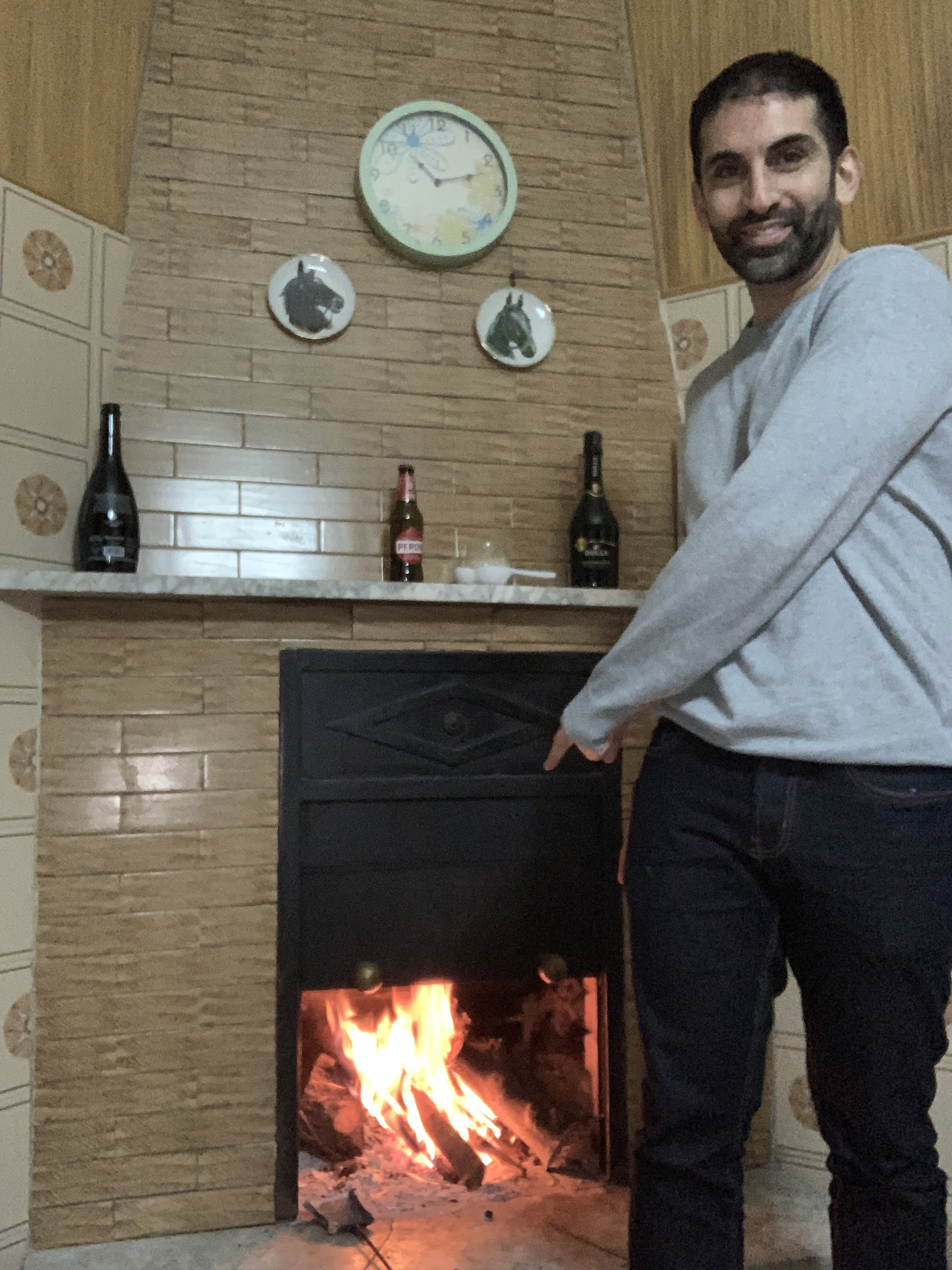
I am here during the Christmas holidays, and will stay until mid-January, after which I will fly to Shanghai to take on a new teaching position. While in Italy I am staying in an old family house, where my mom, as well as my maternal grandad, were born and raised. There is no modern heating, and so for warmth while indoors I have to light the fireplace. My routine has been to do that early in the morning immediately after rising, at around 6 AM, and then spending the entire morning in front of the glowing flames working on the various projects which need to be completed. In this blog post, I will reflect on this new routine with a particular focus on the strange fascination and primal pleasure of fire. 

Look Mom, I can do it on my own!
I have been coming to this old house in Southern Italy almost every year since I was a little boy, mostly during the summer. The last time I was here in the winter was perhaps 12 years ago, and at the time it never occurred to me to use the fireplace, in part because during the day I’d be at my uncle’s apartment, which has all the accoutrements of modern life, such as gas heating and wifi. And so I only slept in the old family house, and thick blankets provided sufficient warmth at night. This time, I am spending much more time in it, as when needed I can connect to the internet via my mobile phone, and I can consequently spend the mornings in blessed silence working in front of the fire. 

 I am almost 45 years old, and never properly lit a fire until this winter. When I first tried, I clumsily placed a large log on some crumpled paper and assumed that, after lighting the latter, the former would quickly go ablaze. Hah! How wrong I was, and how humbling it was for someone with a PhD to be unable to carry out a most simple task which ensured the survival of our ancestors.  My uncle showed me the proper method of 1) placing a large log near the back, 2) positioning smaller logs on top but in a way which allowed space for the oxygen to fuel the flame, 3) place highly flammable paper below the smaller logs, and 4) continuously feed the paper until the smaller logs burned autonomously. It took 3 or 4 attempts to get it right, and when I did, I felt a huge sense of accomplishment, similar to the feeling of riding a bike for the first time without training wheels or external support. 
 
Since then (at the time of writing, about two weeks ago), I have been lighting the fire every morning, and am struck by how enjoyable the process is. As ever, I have reflected on the reasons for this effect, and have arrived at several potential conclusions. 
 
The first is the sense of relief from the warmth. Just as, when one is hungry, eating food is immensely enjoyable, when one is cold the onset of warmth is pleasurable. It is a primordial pleasure associated with survival, and so in this sense likely activates the most primitive part of the brain. Perhaps this explains the sensual, almost unconscious aspects of attraction to the fire, that feeling that it is pulling me closer, demanding my attention and care independently of will or of the more rational and cognitive faculties.
 
The fire stimulates almost all the senses, particularly touch, sound, sight, and smell. Lighting the fire, like trying to seduce a potential lover, takes effort and action, trial and error, for the tinder to turn ablaze, but the process continues even after this crucial first part is accomplished. Tender care is required to keep the blaze going so that it continuously emits that satisfying heat: logs must be repositioned, for example, to go closer to the flame. Meanwhile, the fire exudes a soft light which dances on the surfaces of whatever object is facing it, mingling an orange glow with shadows as they dance to the rhythm of the throbbing heat consuming the logs. The smell of wood burning is pleasant, while the light whooshing sound, as if inhaling deeply, of the climaxing flame, and the crackling sound of the consummation of the wood, is first intense, then soothing and relaxing. At a certain point, the fire reaches a kind of stable equilibrium, whereby it is mostly autonomous, and here, I am able to concentrate more on my work; but in the background, the heat, sounds, lights, and smells are creating a very pleasant ambiance.
 
Another discovery is that lighting, tending, and sitting by the fire is a quasi-spiritual experience. I have been doing mindful meditation for years, and one of the key purposes is to train one’s mind to live in the present moment. The reason is that much mental stress, as well as anxiety and depression, arise in part because of the tendency to obsess about things that happened in the past, or to fear things which may happen in the future. It follows, ipso facto, that when we live in the present moment, we are less likely to pointlessly ruminate over things we have no control over, and calmness, tranquillity, and even a sense of freedom are the result. The fire can achieve a similar outcome if only because the simultaneous simulation of the senses in the present moment militates against obsessing about the past or future. It reminds me of being on the beach in Tulum, Mexico, in the winter of 2021-2022, during sunrise, as the soft heat of the rising sun and the light salty wind gently touched my skin, the sound of the waves splashing the shores, the sand beneath my feet, combined to help me perceive and feel the moment with an intensity which made me oblivious to anything outside of it. 
 
The fire has a spiritual meaning in another sense. While observing the flames as they consumed the wood, I was struck by a sense of being in the presence of a powerful primal force with the transformative power to give and destroy life. This element allowed our ancestors to survive in the cold, and to cook meat, which further contributed to human’s prodigious expansion across the earth. The lack of fire for heating and eating ultimately could be a question of life or death. At the same time, the very heat which provides so much comfort and upon which life depended could quickly and mercilessly turn everything of value, including life itself, to ashes. Countless lives perhaps have been lost to fire, as have innumerable forests. And then, as if through magic, this process of destruction generates new life. The ashes from the flames can become fertilizer to grow more and healthy vegetation, which then go on to feed more people, which increase in numbers, and so on, in a never ending cycle of destruction and birth which characterizes all organic life. In our comfortable Western lifestyles, in which we deny or purposely forget the reality of death, it is easy to ignore this primal fact of nature. And yet for some unexplained reason the simple act of lighting and tending the fire forced me to face this reality and reminded me of why the ancients either worshiped fire or attached deep religious significance to it. 
 
Closeness to nature, then, is one of the main benefits of my stay in the old family house in Southern Italy during the winter of 2022-2023. While here, I have spent mornings in front of the fire, which starts to flicker out about 9:30 AM. At this point, I go and sit on the small balcony on the second floor and take in the warm rays of the rising sun, the same sun which nourishes the plants which feed the planet’s population, including me, or which, in other contexts, may cause heat waves with deadly consequences. I go from one source of warmth, the fireplace, to another, the sun, both primal elements of nature, both givers and destroyers of life.

Thursday, November 3, 2022

Review of Thomas Mann's "Death in Venice"

Thomas Mann’s Death in Venice tells the tale of Gustov Von Aschenbach, a middle-aged and successful German novelist during the early 20th century. Aschenbach’s works are widely read, among general audiences but also in schools as pedagogical tools to teach the techniques and methods invented by masters of the art. As a consequence, Aschenbach has a successful career with a materially comfortable, even affluent, existence, with multiple homes, each for a different season, and servants to attend to his needs. And yet he experiences what today many would call a mid-life crisis. In his early 50’s, already widowed, and deeply unsatisfied with the elements which weave the fabric of his life—the routines, surroundings, frequent contacts, work and leisure habits. While out for a stroll in this gloomy state, he spots a foreign looking man who evokes the idea that he needed a foreign adventure to free him from his emotional and spiritual cul-de-sac. Exotic food and a hotter climate, a beach from which one can soak up the sun and bathe in the warm waters of the Mediterranean—these, thought Aschenbach not unreasonably, would help lift his spirits and bring back his zest for life. 

The rest of the plot revolves around this adventure. He takes the train to the coast, and from there, goes to Italy via passenger ship. Perhaps representing an omen of his coming misfortunes, on the ship the food was horrible, the quarters uncomfortable, and among the passengers there is a group of performers composed mostly of young men, but among this group is an inebriated old man who tries to hide his age using various articles—his hat, glasses, hair, etc. His attempt to fit in, as it were, could not efface the sagging skin, wrinkled hands, brown or missing teeth, and other signs of the passage of time, of decay and decline, which, as we will see, is a major theme in Death in Venice.

There are two key events in Venice which seal Aschenbach’s fate. The first, and most important, is the presence of another guest, a statuesque and gorgeous Polish boy of 14 years old named Tadzio, a member of the aristocracy, who is vacationing with his family. Aschenbach almost immediately becomes infatuated with him. This fateful—and ultimately fatal—attraction was almost nipped in the bud because, shortly after arriving, Aschenbach decides to leave Venice as he found the stifling summer heat intolerable. When he arrives at the train station, he discovers that the hotel mistakenly sent his luggage to another destination, and so as fate would have it, Aschenbach remains in Venice.


A Fatal Attraction


While there, his obsession for Tadzio only deepens, perhaps because it is never consummated, nor is the attention equally reciprocated. Aschenbach sees Tadzio frequently in the hotel restaurant and on the beach, and in the latter location, he could focus on the perfectly picturesque proportions of Tadzio’s exposed youthful body. There are a few fleeting moments when it appears as if Tadzio notices he is being watched and reciprocates the attention, and, of course, the infatuated Aschenbach imagines that perhaps the boy feels the same way. But the skeptical reader could just as easily conclude that Tadzio was motivated by mere curiosity, and that even if he were gay, attraction to the aging Aschenbach was perhaps not the motive for the momentary glance. 

In one scene, Aschenbach sees Tadzio up close and notices that there are signs of sickliness—he has fragile not gleaming teeth, and anemic skin. Below the surface of Tadzio’s godlike beauty, therefore, was a very different and ominous reality. 

The city of Venice has a similar dynamic. In some of the more beautiful passages of the text, the reader encounters vivid descriptions of this unique city’s splendors and wonders—its zigzagging canals pass by medieval buildings with Greco-Roman columns, Arabesque windows, and Byzantine cupolas. This beautiful landscape is enriched by the tourists from all over the world filling the streets and alleys, adding colour to the local population of hot blooded and passionately expressive Italians. But the reader soon discovers that there is a Cholera outbreak in Venice, and that the corrupt authorities were reluctant to reveal the truth about it because it would devastate the tourist industry. Aschenbach suspects something is awry, particularly when he notices public health officials disinfecting public spaces, and the streets slowly emptying, but locals respond to his inquiries with lies, saying it’s a routine measure. Finally, he discovers the truth from—perhaps not surprisingly—an Englishmen who works as a customs official in the city. The disease, which spreads through water and leads to an excruciating death among a staggering 80% of the infected, arrived via boat, and officials’ attempts to stop the epidemic were an utter failure. Aschenbach himself contracts the disease and eventually dies while sitting on the beach staring at the object of his obsession. 

This ignominious outcome, of course, could have been avoided had Aschenbach left Venice earlier, as he had wanted to. The reason for staying, as mentioned above, was that his luggage was mishandled, but the text makes clear that this was not determinative. Aschenbach nudged fate in his preferred direction, or did not resist fate when it accorded with his wishes. For example, one reason for his luggage being mishandled was that he wanted to stay in the hotel just a bit longer to capture a few more glimpses of the beautiful boy, even though there was a car ready to take him and his luggage to the train station where the train would soon be departing; at this moment, he instructs the hotel staff to send his luggage to the station, while he would arrive shortly after. When he finally arrives, he discovers that his luggage was mishandled, but he still could have boarded, and waited for his luggage at the next destination. Instead, with the boy at the forefront of his mind, he chooses to stay in Venice with the excuse, or rationalization, of his missing luggage. When the fateful decision to not board is made, his sense of relief is palpable, because now it would mean he could continue to indulge his puerile fantasies in Tadzio’s presence.

A connecting theme in the subtext is decay or rot beneath the visible or superficial beauty. This is not surprising, given that another classic by Thomas Mann read by my book club, Buddenbrooks, has similar themes (my review of that book can be found here). Below the surface of Aschenbach’s affluent life, and successful career, one discovers depression and deep dissatisfaction; under Venice’s strikingly beautiful fairytale like façade, there is a raging epidemic which kills by, among other things, starving the body of necessary fluids, and a corrupt administration unwilling to be honest about it; and, of course, the godlike and statuesque beauty of Tadzio only temporarily hides the underlying anemic disposition which was a manifestation of poor health and, at least at the time, predicted an early grave. The major truth that Thomas Mann seemingly wants to impart—in my view successfully—is to look below the surfaces, as appearances are deceiving and misleading; a little probing almost always reveals a darker, menacing, reality which afflicts all living things, whether they are humans, cities, or societies—decay, rot, disease, fragility, and death. 

This review would not be complete without a few lines on the aesthetic quality of Death in Venice. On this point, all the members present at the book club meeting agreed that the text is beautifully written, much more than, say, is the case with Buddenbrooks. Not only is the prose poetic while rendering the scenery visually stimulating; there are many lines which provoke deep thought. For example, while sitting on the beach, Aschenbach reflected on his love the sea as it satisfied:

“the desire to take shelter from the demanding diversity of phenomena in the bosom of boundless simplicity, [and conveyed] a propensity for the unarticulated, the immoderate, the eternal, for nothingness. To repose in perfection is the desire of all those who strive for excellence, and is not nothingness a form of perfection?”

This line stuck out for me and for other members of the book club, as it is emblematic of the prose as it appears throughout the text—flowery, poetic, philosophical, but also very beautiful. It was partly for this reason that all members rated Death in Venice very highly. Sadly, it will be my last book club meeting for a while, as I will soon be going overseas to start a new teaching position, and may not be back in Toronto until the Spring or Summer of 2023. In the meantime, of course, I will continue to read the classics and post my reflections on this blog.


Sunday, October 23, 2022

Review of Gogol's "Dead Souls"

In September of 2022 it was my turn to host a book club meeting, which meant I had the privilege of selecting the book. I chose Gogol’s Dead Souls because it was given to me as a gift by a former student with whom I have kept in touch over the years, and I felt morally obligated to read the book; of course, I was also looking forward to reading another classic by a 19th century Russian author, given how much I have enjoyed reading the work of his contemporaries such as Tolstoy, Dostoevsky, and Pushkin. As usual, while reading the text I underlined important passages and commented in the margins, mostly with the aim of discovering a connecting thread or an overarching theme which would provide me with a general impression upon which I would base my evaluation. 

That’s not what I discovered in Dead Souls. There is a main plot (see below) and a key character, but his adventures and exploits do not seem to convey a deeper and singular truth; in this blogpost, therefore, I will briefly summarize the plot, and highlight the jumble of themes to which it is connected, which appears to be a rickety assemblage of contradictory elements about Russian identity and Russian society in the mid-19th century. Adding to the sense of general lack order—but not necessarily lack of artistic quality—is Gogol’s strange writing style, in which the story does not unfold in a chronologically logical sequence of events. Rather, there are several detours and multiple twists and turns. Throughout the text, moreover, Gogol periodically seems to engage in a kind of Freudian free association directly with reader, as if in the process of writing, there arose sudden and urgent needs for cathartic releases which spontaneously found their way onto the text and which remained in the published version.

Russia: A Riddle, Wrapped in a Mystery, Inside an Enigma 

The context of the story is early 19th century Russia, and it revolves around the personage of Chichikov, who is on a mission to purchase dead souls, by which it is meant serfs who had died but who still existed on paper for the purposes of paying taxes. Landowners were obliged to pay taxes on their serfs, and the census was done infrequently; in the interim, between officials’ collection and updating of information about estates in the realm, many serfs died, while the owner was obligated to pay taxes on the assumption that they were capital generating agricultural value. When the reader meats Chichikov, he or she knows nothing about him other than the fact that he is trying to purchase the title to the dead serfs. The reader accompanies Chichikov as he meets various landowners and tries to convince them to make the sale for the lowest price, and they, as well as the reader, suspect it is a swindle with some nefarious purpose. Nonetheless, they have an incentive to make the transaction, given they are paying taxes for non-physically existing serfs. 


Halfway through the text, Chichikov accumulates 400 dead souls, but the reader is left hanging, as it were, about the overall objective. Is it simply to get rich? The suspicions of the townsfolk only add to the general uncertainty. They suspect he needs it as capital and as part of a scheme to seduce the beautiful daughter of the town’s governor; others suspect more sinister and supernatural motives, such as Chichikov being Napoleon in disguise. To contemporary readers this may sound ridiculous but it actually reflects the fact that Dead Souls was written in 1842, that is, in the shadow of the French invasion and occupation of Russia, which was a historically and nationally defining moment of cosmic importance, perhaps comparable to September 11th, 2001 for contemporary readers. These events tend to produce bizarre narratives and interpretative schemes about the significance of what occurred, which tend to reappear particularly in novel situations which do not fit into general patterns. 

In Dead Souls, the relatively recent French invasion is frequently connected to a theme about the nefarious influence of France and Western Europe on Russia’s supposedly more morally pure culture, a pattern which is still visible almost 200 years later (more on this below). In several scenes, the reader encounters soliloquies about the glories of Russian feudalism, and how attachment to the land, and closeness with nature, helps to forge the best of elements of Russian character. This is juxtaposed with the enervating and spiritually shallow consequences of liberal ideas emanating from the West and particularly France, ideas that many Russians themselves attempted to export to the motherland. Here, there are echoes of Tolstoy, who also posited an existential clash between Russia and France (my review of Tolstoy’s War and Peace which touches upon this theme can be found here).

But—and here is one area where the text is very contradictory—Dead Souls also highlights the corruption at the heart of the Russian system which is what ultimately pressured Chichikov to carry out his big swindle. The first clue is that the authorities continued to tax peasants even after they had died; this inefficient bureaucracy gave owners an incentive to sell them to Chichikov. The second is the development of financial instruments which created opportunities to use peasants, even dead ones, to generate revenue. What is more, Dead Souls highlights how even those who were well off, and did not need more wealth, were driven by ambition and avarice to increase profits, and this often involved greasing the wheels of the system in one way or another, via bribes, or intrigues, or cheating. In other words, another lesson of Dead Souls is that Russian society was corrupt from top to bottom. A consequence of this corrupt system is those without the fortune to be born in well-to-do families must cut corners to get ahead, and so Chichikov’s swindle was not out of place; indeed, it was in many ways, less harmful than other scams frequently occurring. After all, he did not steal any peasants. All transactions were mutually voluntary, and he was helping landowners to lighten their tax burden, which was in any case based on non-existing peasants. He used the title to generate capital which would ultimately be used in actual productive investment which would generate more revenue for public coffers, and which allowed Chichikov to be a good husband and father. In fact, with the help of the capital generated via the dead souls, he gets married, has 11 happy and healthy children, and lives comfortably as a noble on his estate.

Where, then, is the crime here? Perhaps the question mark is precisely the point—there is no straight answer, leaving much ambiguity about what Gogol’s purpose his, or whether he even wrote the book with a broader purpose in mind.

It is midway through the text—and not, as I would have expected, at the beginning—that Gogol paints a portrait of Chichikov which gives some biographical clues about other potential motivations for the big swindle. Gogol tells the reader that Chichikov’s parents belonged to the nobility “but whether to the ancient or the personal nobility God only knows.” He had a sickly mother and a cynical, bitter father, neither of whom showed him much love. From his father Chichikov learned “your friend and comrade will cheat you, and in adversity he will betray you, but money will never betray you.” In school he was taught by violent and cruel teachers, and the one exception, a loving and inspiring instructor, died young. Chichikov eventually becomes a bureaucrat and is presented with opportunities to get rich via accepting bribes. As most others in his position are doing it, so does Chichikov, and he eventually amasses a considerable amount of wealth, but because of a petty dispute with a colleague, he loses most of it. This leads to an existential crisis: “why do I exist? Why has misfortune overwhelmed me? Who cares about his duties nowadays?...I have not plundered the widow…why do others thrive while I descend as food to the worm?” Part 1 of the book (there are 2) ends on this note, with the reader finally having some of the personal details which help to understand Chichikov’s motivation.

In book 2, we learn that Chichikov gets caught for his crimes, and is imprisoned. He is now facing the possibility of execution and has an epiphany which leads him to realize that ambition and avarice have led to his predicament. He pleads with God to save him, promising that he’ll change his ways. At this point, the reader expects some divine intervention leading to Gogol’s release, and his renouncing the material seductions of the world while going to live in a monastery, perhaps becoming a saint. Chichikov is indeed saved, but by the machinations of lawyers and the payment of bribes; perhaps it shows how God works in mysterious ways, or that the corruption which led to Chichikov’s demise also saves him from an early death. In the final section of the book, the reader encounters Chichikov as a member of the nobility, and the main scene is a summit or meeting of the feudal aristocracy. Here, the reader discovers that not only are his aristocratic peers corrupt; some are worse and have been accused of theft and murder. 

Gogol’s Perplexing Prose

It would be worthwhile to briefly reflect on Gogol’s strange writing style, which is of a kind I cannot recall encountering elsewhere. Calling some of the elements a “technique” suggests a strategy with an ultimate purpose, but it is not clear to me that that’s what Gogol is doing. For example, in chapter 6 of book 1, the reader is suddenly and unexpectedly treated to a soliloquy about aging:

“…Now I approach every strange village with indifference, and glance indifferently at its tasteless exterior; it is displeasing to my cold gaze: that which would, in former years, have called forth a lively movement in the muscles of my face, laughter and endless remark, is no longer amusing to me; it now slips by me, and my motionless lips preserve an interested silence. Oh, my youth! Oh, my youth!”

This harangue is written in the voice of Gogol and not that of Chichikov or any other character of the book; it appears utterly disconnected to what preceded it, and when it ends the reader is abruptly re-introduced to Chichikov’s quest to purchase dead souls. It is as if, in the process of writing, Gogol spontaneously wanted to momentarily deviate from the story to speak directly with readers.  One encounters this frequently in the text, as at the beginning of chapter 7, when the reader is offered some Freudian associations about the nature of happiness, reflections which do not flow, logically or sequentially, from the content which preceded, and ends with Gogol exclaiming “to my tale! To my tale! Away with the wrinkle which has intruded itself on my brow, and the dark gloom on my face! Let us fling ourselves with…and observe what Chichikov is doing.” And the story resumes. Or on pg. 238, when Gogol ponders if “it is very doubtful whether the hero of our choice [Chichikov] has pleased the reader,” and on pg. 261, “there still lives in the author’s mind the invincible conviction that readers might have been pleased with this same hero, with this very Chichikov.” 

I am a political scientist by training and so I do not have the expertise to theorize this literary approach, but I can speak to the effect, which is that it creates a sense of weirdness, or that it is discombobulating. At the same time, it leads to a sense of directly communicating with the author, which in a strange way induces the impression that he is telling a true story about a real flesh and blood human being who lived at this moment in history. If this is the purpose—and it’s a big if—I admit it is very effective in helping to blur the boundaries between fact and fiction, story and reality, a novel and a documented history. 

Another possibility is that this effect is purely unintentional as the writing style reflects Gogol’s disordered and unstable mind rather than any strategic literary genius. After all, he did suffer from mental illness and died very young. 

Finally, Gogol’s Dead Souls can also be read as a kind of anthropological treatise on the content of the Russian soul. There is plenty of content on this theme, and, like much else in the text, it is contradictory (perhaps because national identities inevitably are). Over here, we are told “Russians do not like to die in bed,” over there, that “a Russian man is capable of anything and can adapt himself to all climates.” In one scene we learn that “Russian ingenuity only makes itself known in cases of emergency,” and in another, referring to the character General Betrishchev, “good qualities and a multitude of defects, as is usual with Russians, were mingled in a sort of picturesque disorder. In decisive moments he displayed magnanimity, valor, wisdom, unbounded generosity, caprices of ambition, petty personal touchiness.” Elsewhere, we hear that “a Russian man is a lost being. You want to do everything and can do nothing.”

What to make of this jumble of observations? One plausible hypothesis is that Gogol spent half his life abroad, and in fact Dead Souls was written while he sojourned in Italy. As is often the case, distinctive national traits become visible when one encounters and lives among foreigners. As the proverb goes, it is through others that the self is discovered, and this is no less true between groups than it is among individuals. 

In the text Gogol’s repeated assertions on the character of the Russian soul bestride the content on Russian identity which is connected to an existential cultural chasm between Russia and the West. At the time, it was the ideas on progress and equality emerging out of the French revolution which did not sit well with Russia’s glorification of the land, romanticisation of ruggedness, its religious rootedness, and morally pure pastures. In the 21st century, the vocabulary has changed, but one can still detect this clash in the conflict between the West and Russia, when Westerners disparage the country as backward and authoritarian, while Russian leaders, mostly notably Vladimir Putin, warn against importing the West’s moral decay, decadence, and hedonism.  The fact that this clash continues, almost 200 years after Dead Souls was written, highlights that one of the benefits of reading the book is to deepen one's  historical knowledge about trends which have been present for centuries and which re-emerge in the human pageant under new guises and banners. 


Wednesday, August 10, 2022

Reflections on Madrid and Spain during the Spring and Summer of 2022.


I spent the Spring and Summer of 2022 in Madrid, Spain, in total for a period of four months. The main reason for the trip was to carry out research for several forthcoming publications, all of which are about Populism and Foreign Policy in Southern Europe. During the first 6 weeks I stayed at a place close to Plaza De Espana, and for the rest in the very centre of town, Puerta del Sol. During the day on weekdays I did my work at the National Library, but I also engaged in many social activities which led to the development of meaningful friendships and to a relatively deep integration into society in Madrid. Moreover, I visited several of the country’s historical treasures, inside and beyond the capital city. These experiences were extraordinarily enriching and will be the focus of this blog post, with particular attention on the general impressions of the city, the country, its language, and culture.

In 2021 the Canadian Foreign Policy Journal published an article I wrote called “Populist Foreign Policy: The Case of Italy” (the article can be found here). Little did I know at the time that academic publishers would become very interested in the theme, and as a result, shortly after the article was released, I was presented with two opportunities to publish on populism and foreign policy in Southern Europe, including Spain. For the past several years my work has focused mainly on France and Italy, and to develop expertise on Spain I would have to travel to the country, consult texts unavailable elsewhere, interview locals, and master the language. With these objectives in mind, I arrived in April and stayed until the first week of August. 

For the most part, I would spend my days in the National Library, which itself is an architectural jewel, with neoclassical designs both in the interior and the façade, adorned with impressive statues of Spain’s illustrious thinkers. The library contains many rare and valuable texts, and some have been stolen in the past; consequently, gaining access to the library requires obtaining permission, which involves submitting documents confirming one’s nationality, address, and status as a researcher, then waiting one week to obtain the access card. All sources must be booked online before they can be physically consulted, and the client must wait for the confirmation that the sources are available, after which access is granted. To enter the premises, one must pass through security, leave personal belongings in a separate room, pass through another layer of security, go to the main room to obtain the sources, and then go to an allotted desk in the main reading hall where the books can be read and analysed.

Initially I found this process annoying and excessive, but as in most things, I got used to it. After spending the day in the library, in the evenings I would engage in social activities which can be found on the popular app “Meetup.” During the first few months, the main one was language exchange events, where native Spanish speakers can meet Anglophones and practice their native tongues with one another, ideally in a manner that allows improvement (for example, correcting each other's mistakes). Doing this was extraordinarily valuable, especially since I had learned, and was used to, the Spanish spoken in Latin America, and needed to adapt to the castellano spoken in Spain. As well as the different accent, there are some non-trivial differences in vocabulary, and a few examples will illustrate: when saying “right now”, Latinos say “ahorita”, while in Spain they say “ahora mismo”. “Congratulations” is usually expressed as “felicitades” by Latinos and “enhorabuena” in Spain. “llevar” is commonly used in Spain to mean “bring,” “carry,” “going,” "getting along," or “have been”; when I was in Mexico, I don't recall hearing “llevar” used in so many different contexts despite almost two months of full immersion. 

One of the more enchanting aspects of Spanish—and this is true both in Latin America and in Spain—is how frequently the diminutive is used, as in “una cerveza” (a beer) often becomes “una cervez-cita,” or “un euro” (one euro) becomes “un euro-cito”. One finds the diminutive in the most unlikely places, such as (my personal favourite) “covid-cito”. When directly translating to English, these words—little euro, little beer, little covid—lack the full breadth of meaning in their Spanish expressions, and one reason is that the diminutive itself has multiple meanings. It is not only “less” in the quantitative or material sense, but also in the psychological one, as in emotionally less burdensome. It is also a conscious attempt to minimize a suggestion or question the hope of making it more acceptable. In some contexts it seems to have a similar function as baby-talk, as when adults change the tone and texture of words and sentences while communicating with children.

Participating in language-exchange events was rather easy, because almost everyone, often unconsciously, adapts their communication to their language-learning interlocutors, meaning that words are clearly, fully, and loudly pronounced . It was more difficult to attend social events where there were exclusively Spaniards, and I would be the only foreigner. I waited about one month before going to these latter types of events, and initially it was challenging, because when native speakers talk among themselves, the pitch is faster, more words are truncated, and local colloquialisms are more common. As I participated in these conversations, over a period of approximately two months I went from understanding roughly 80% to 98% of what was being said, and naturally this created opportunities for me to be an active participant in these events, most of which were discussions or debates on philosophical or spiritual themes.  Doing this allowed me to make the leap to a much more advanced level of Spanish, and it also gave me a deeper understanding about the people who live and work in Madrid (whereas language exchange events are often filled with travellers). Many became friends with whom I developed genuine affective bonds. In comparison with the many countries I have visited and lived in, I can confidently say that people in Madrid are among the most friendly and welcoming I have ever encountered. I am a bit puzzled about the cultural origins of this tendency, although I suspect it’s a mix of the city’s cosmopolitanism, Catholic universalism and Mediterranean sociability.

A noticeable feature of Madrid is its demographic composition, which is very different from the other major cities—Rome, Paris, Toronto, New York—that I am familiar with. All these cities are very diverse in the sense that there are large numbers of blacks and Asians as well as whites; in contrast, in Madrid the vast majority of non-Spaniards are from Latin America, whom, of course, are very diverse, from the Indigenous, to white, to mixed race, and black. At many of the events which I attended, up to half of the participants were from Latin America, mainly Columbia and Argentina, although Uruguay and Peru are also highly represented. Many have been in Madrid for a long time, and so they are fully integrated, a process made easier by the shared language and culture. 

Plenty of the local friends I made are originally from Latin America, and out of curiosity I asked them whether they had ever experienced discrimination. Several replied that they had occasionally received condescending or disparaging comments from former employers, but that overall, they had smoothly integrated. This response fit with my own experiences of closely observing how Spaniards and Latinos interacted as friends, lovers, or co-workers; sharing the same language and a similar culture blurred the national differences between them or, in many contexts, made them utterly irrelevant or trivial. It was noticeably different from my own experience in Toronto, growing up in an immigrant family with a language and culture--Italian--different from the host country's; my mom, for example, would often contemptuously refer to “i canadesi” (“the Canadians) to refer to Anglo-Saxon members of the country even though by then she had already obtained Canadian citizenship. One reason was that she had never really integrated into Canadian society—her friends and partner were Italian, as was the media she consumed, and so her contact with Anglophone Canadian society was very minimal.

One of the unique aspects of Spain is the Islamic influence, which is unambiguously visible in the physical characteristics of the people, the architecture, and the language. Spaniards are considered “white” Europeans, but upon close inspection it becomes clear that many are the descendants of the Arabs who ruled the peninsula for 8 centuries. This is unsurprising, given that, after the Reconquista, Arabs, who numbered around 300 thousand, were given the option to convert to Catholicism and stay, or to go and live in Islamic territories. Estimates are that around half took the former option, meaning that they assimilated into the broader population. In the process, not only did they contribute Arabic physical features to the ethnic make-up of the country, they also strongly influenced the language, such that many habitual Spanish expressions are Arabic in origin. The most common one is “Ojala” which means “hopefully” and comes from the Arabic word for God Willing, or Inshalla. Another common word is “hasta” which means “until” and comes from the Arabic “hatta.” 

The enchanting Arabic influence can be seen in the resplendent buildings and cathedrals which combine Roman, Gothic, and Arabic architectural styles. In Madrid, which itself was founded by the Umuyad Emir Mohamed the First, very little visible Islamic influence remains, but in nearby Toledo, the cathedral, which is easily one of the most beautiful I have ever seen, contains the well-preserved remains of the medieval mosque. The same is true in Segovia, where Arab styles can be seen in most of the prominent buildings, whether secular or religious, even though many were built after Muslims were expelled, highlighting that Arabs continued to influence the architecture even after the collapse of their empire. This influence is most evident, of course, in AndalucĂ­a, in Southern Spain, which the Arabs called Al-Andalus. Granada and Cordoba were Arab centres of power and culture during Islam’s golden age, when Christians, Jews, and Muslims coexisted under Muslim rule, leading to a flourishing of science, philosophy, and architecture. Visiting these two cities was easily one of the highlights of the trip, given that this has been on my bucket list for years. Words cannot do justice to how beautiful and intriguing these cities are, and so hopefully the pictures below give a better sense.


Alhambra (Granada)

Cordoba

Inside mosque-cathedral Cordoba

Alhambra 


View of Cordoba

Inside mosque-cathedral of Cordoba. It was 40 degrees that day.

Entrance to mosque-cathedral of Cordoba


Finally, and moving to a completely unrelated theme, I would characterize this trip to Spain as my first post-pandemic travel, even though the virus continues to circulate. Since the beginning of the Covid plague, I have travelled many times—to Paris, Barcelona, Naples, Havana, and Tulum—and the trip to Madrid was the first one where I finally had the sensation of pre-pandemic normality. At the events described above, I would be in locations packed with unmasked people,  where greetings occurred with the typical Mediterranean affection gesture of the double kiss. Most importantly was doing this without the fear that the other person was a carrier of some deadly virus, and this was felt even though  a “seventh wave” of Covid occurred in July 2022, when I was in Madrid. The difference with last summer is astonishing. I went to Barcelona in July 2021, and the “fifth wave” occurred while I was there. While in Barcelona I was exposed to the virus twice, and this led to panic in part because of rules on mandatory isolation after exposure. The situation was so tense that I decided to leave Barcelona earlier than planned. In Madrid in July 2022, I was exposed to Covid several times, and not only did I not catch it, but most importantly, it did not cause any paralyzing fear. How liberating after the terror of the past two years! 


Friday, November 26, 2021

Review of Arthur Miller's "The Crucible"

Arthur Miller’s The Crucible tells the story of the Salem witch trials, which occurred in the year 1692. A collective hysteria developed in the town after several children fell ill, and many babies died at birth. The reigning authorities’ explanation was witchcraft, and evidence for this included the discovery that young girls were surreptitiously dancing in the forest, which was interpreted to mean that they were secretly communicating with the devil. This belief system spread like a virus and eventually became the unquestioned orthodoxy of the courts, which had supreme authority to identify the innocent and guilty. Arthur Miller was inspired to write the text because he was a victim of the collective hysteria of his time, namely McCarthyism, a period in which witch hunts were carried out against those suspected of having communist sympathies. The more sinister aspect of McCarthyism, as in the Salem witch trials, was that authorities, who are supposed to serve the common good, became agents of division and tribalism which destroyed the bonds of civil society. In both cases, as in other mass hysterias, independent thinkers who raised legitimate questions about government policy were scandalously punished, ostracized, and persecuted.

The text is a masterpiece which should be required reading for students of politics, because it shows how power operates during those periods when certain beliefs become orthodoxies among people who occupy the highest echelons of the state’s bureaucratic apparatus. A small minority is able to recognize the political psychosis, and The Crucible is also a story about these types of semi-heroic figures. It is not the most educated; on the contrary, The Crucible demonstrates how the educated class plays a pivotal role as transmitters and perpetuators of the hysteria. Rather, it is the rule breakers, or those whose livelihood is independent of the authorities, who can see what is actually occurring. But even for them, dissent carries a high price, and an inflection point is reached when they must either choose the path of conformity, which brings material comfort and security, or their conscience, which brings pain, exclusion and persecution. 

In the opening scene, the reader encounters Betty, who is delirious and unresponsive, lying on her bed, surrounded by her father, the Protestant Pastor Parris, convinced that she is possessed. The devil is stalking Salem, preying on victims, particularly vulnerable young girls like Betty, and evidence for this, Parris and others believe, is that the girls were dancing in the forest (dancing was banned in Salem). When this belief takes hold, the accused are pressured to confess their crimes and renounce the devil; this would expiate their sins and make them “pure” enough to re-enter the community. Those who refused to confess were publicly hanged. Understandably, many dishonestly complied, as lying and betraying oneself seemed like a small price to pay to avoid an untimely, humiliating, and excruciating death. It was Salem’s highest authorities—lawyers, judges, and Harvard-educated theologians—who were the agents of this charade. Most others went along out of a combination of sincere belief and fear of both the invisible enemy (witches) and of the awesome power of the authorities who arrogated to themselves the right to monopolize how this enemy would be interpreted, understood, judged, and acted upon.

But not everyone fell into line. One of The Crucible’s main characters is John Proctor, a strong, hard-working independent farmer. He does not work for the state and hence his livelihood is not dependent on accepting its narratives. He is a “sinner”, but in the moral not criminal sense: while his wife was sick, he committed adultery with Abigail. The latter, in turn, is participating in the hysteria, claiming to be in communication with the devil, whom, we are told, reveals to Abigail his agents in Salem. Abigail says that Mary Warren, John Proctor’s wife, is among those whom Satan is using to curse the good people of the town. Proctor can see what the real motives are: Abigail desires Proctor, but his wife Mary Warren stands in the way. If the latter were to be tried and executed for witchcraft, Abigail could marry the man she covets. Thus, Proctor’s regrettable betrayal of his saintly wife also allowed him to see that, below the hysteria, other motives were at play. Once that bubble has been punctured, it becomes easy to see sinister motives elsewhere. For example, a farmer Putnam had a property dispute with his neighbour, and the Salem witch trials represented an opportunity to exploit the hysteria for material gain. 

A striking feature about the witch trials is that the authorities were utterly blind to these ulterior motives despite the evidence being in front of their eyes. There is an exception: Hale, the brilliant theologian, arrives in Salem from Boston to help the authorities deal with devil’s machinations, but after a series of interviews and observations, he recognizes that many of the accusers are lying. His voice of reason is drowned out by those of other authorities who, by then, had already executed dozens of suspected witches, and could not fathom that they may have been wrong.

When the pregnant and saintly Mary Warren is arrested because of Abigail’s false testimony, Proctor must convince the court that her accuser is a liar, and so he must confess his marital infidelity. While he is questioned, he also reveals his belief to the authorities and the public that the witch trials are a farce. He is arrested and languishes in jail for three months. On the day of his execution, he is given the opportunity to confess the sin of witchcraft and, in so doing, avoid the hanger’s noose. For average men, going along with the lie would have been easy, but Proctor is a man of integrity and conscience, and hence must struggle. The pressure on him was immense, because his pregnant wife is present, and she needs him to remain alive to feed the family (they already have three children). He buckles and dishonestly vocally confesses, but then, the judge asks him to put it in writing. Proctor could not proceed and destroys the document he was supposed to sign, while yelling the truth to the judge that the whole thing was nonsense. Shortly after, he is hanged.

The Crucible is a timely reminder that societies periodically experience collective hysterias, and despite differences in culture and historical epoch, they share certain patterns. One is that everyone’s attention becomes focused on some external, malign, and invisible force, such as witches or communists, which are perceived to cause some sort of pathology. Subsequently, an elite class of actors, usually politicians but also judges and experts, arrogates to itself the right to save the community from this mortal threat by monopolizing how it will be interpreted and acted upon. Their actions, in turn, help to fixate everyone’s attention and fuel the hysteria. Saints and sinners are created by the authorities because they categorize those who go along with their narrative as “good”, and those who dissent as “bad”. The latter face many punishments, from execution to unemployment to ostracism. Interpersonal and civic bonds are destroyed, sometimes irreparably. One of the more pernicious aspects of these events is that authorities become so entangled and invested in the orthodoxy that, when evidence emerges that they may be wrong, they double down rather than critically question their own beliefs. The most cynical reason is that they are saving their skin, as they are fully aware that admitting they may be wrong would mean publicly recognizing that all the pain and suffering was pointless and cruel. Although they may escape justice, history is never kind to these petty tyrants, while heroes like Proctor are vindicated because their perspicacity, courage and integrity prevented them from following the herd.