Tuesday, January 12, 2021

Havana during the holidays of 2020

I am writing these introductory lines while sitting at the desk in my hotel room in Havana, in front of a window which overlooks the bay of Cuba; I can see the waves gently splashing against the fort built by the Spanish in 1589 to protect their territorial acquisition from (mainly English) invaders. I travelled alone to pass Christmas and New Year’s eve in the country, and it is the first time I have been outside of my home, Toronto, during the holidays. I decided to make this trip for three reasons. One is that I am nursing a bit of a heartbreak as a consequence of relationship which ended in November. The second, and related, reason is that it is a bad time to experience heartache in Toronto: the city is in full lockdown, and almost everything is closed, while we are expected to avoid in-person contact with others. Consequently, the events that usually bring me joy during the holidays—big family get-togethers, Christmas concerts, meeting friends for dinner or a coffee—are not possible, meaning I’d be spending most of the time alone in my 550 square foot condo. Thirdly, in March of last year, I began learning Spanish, and wanted to be immersed in the culture of a Spanish speaking country, where I would have opportunities to frequently talk with native speakers. For all these reasons I had a strong desire to travel, and I chose Cuba because it is one of the few Spanish speaking countries where the pandemic is relatively under control. In early December I purchased tickets for a two week sojourn.


View from my hotel room


 This is the second time I have travelled during the pandemic. The last time was when I went to France in the summer of 2020. That trip was anxiety-inducing, but it also helped me to understand that it is possible to travel relatively safely during these crazy times we live in. Flying was very different this time. The flights to and from France were almost empty; in contrast, the flight to Cuba was full, mostly with Cubans returning home, rather than with tourists. Upon arrival to the airport, all passengers, without exception, were administered a Covid test. After leaving the airport, I had to go to my hotel, and could not leave the premises until the public health authorities contacted management to inform them of my result. I waited two days, and upon obtaining the green light, I felt an immense sense of relief, although admittedly in the hotel I did not feel very constrained; while waiting for the test result, I passed the time reading on the terrace overlooking a Havana street while soaking in the warm air, soft breeze, and urban landscape, or walking around the relatively large hotel premises and speaking Spanish with the very friendly staff. 


Although the pandemic in Cuba is mostly under control, signs of it were evident around the city. The most visible was the ubiquity of masks: in Havana they are obligatory, including outdoors, and must cover the nose and the mouth. During my two week stay, I rarely saw anyone not wearing a mask properly, even though there were hardly any police on the streets. Unlike in North America, where anti-maskers often protest against this unconscionable symbol of servility, Cubans mostly accept the minor inconvenience of covering their face for the collective good of society. Facetiousness aside, another feature of the pandemic was the relative lack of tourists. Staff at the hotel told me that tourism collapsed 80%; this was clear on the streets where only the odd European or North American could be seen. Lastly, although bars and restaurants are open, nightclubs are not. In some other respects, life appeared to be as it was before the pandemic, particularly in public transport; to get around I took packed buses almost every day where mask-wearing Cubans of all ages were squished together. 


Packed bus in Havana


A notable feature of this trip is that I have a Cuban friend who lives in Havana. He has an interesting family history: before the revolution, his mother delivered messages between the rebels camped in the hills and those hiding in the city, while his father was one of Che Guevarra’s personal bodyguards. When I went to his house for dinner one day, his mom recounted the details of those events and showed me pictures of she and her husband with Castro, Guevarra, and other icons of the revolution. She is in her mid-seventies, and hence was a teenager during pre-revolutionary times; I asked her how it was, and she affirmatively replied “mal!” (bad), recounting instances she witnessed of police brutality against innocent civilians. (Interestingly, she is a devout Christian despite being a firm supporter of the socialist revolution. In other countries, the two belief systems often clash and people are either on one side or the other).


Upon arriving in Cuba I knew little about the country other than what I read in history books. Having a local friend with local knowledge was very valuable in reducing the frictions and uncertainties of visiting a country for the first time. Although he and I spoke English (he lived in Canada for 20 years and speaks both official languages), he introduced me to his friends and family with whom I spoke only Spanish, and this allowed me to practice and improve my knowledge of the language considerably. When I arrived, I was probably at the beginner-intermediate level; by the end of my trip, I was above the intermediate level and would probably obtain advanced had I stayed one more month. Getting used to the local vernacular was quite the challenge, because I learned standard Spanish using a language app (Pimsleur), where words were expressed fully, slowly, and clearly; in Cuba, people spoke rapidly, often truncated the words, and used a distinctive local vocabulary.


These experiences of hanging out and speaking frequently with locals taught me other interesting things about the country. One is the state of race relations. Walking around Havana, I did not see much evidence of racism—mixed raced couples, friends, and families seem to be the norm. When addressing one another, Cubans of all races often say “mi hermano” (my brother). This piqued my curiosity, and so one day I asked my mixed-race Cuban friend, who is 48 and has lived in the country for most of his life, whether he has ever experienced racism. “No”, he flatly said, although he qualified this by stating that that does not mean there is no racism in the country. One reason for this relative lack of racism, I surmised, is that there has been much more racial mixing and hence many more mixed race offspring, creating blurry and fluid distinctions between racial groups compared to say, in Canada and Europe. This is evident in the physical features of many Cubans. In Canada, it is often easy to identify someone who has one white and one black parent. Not in Cuba; many light skinned people have dark skinned parents and vice versa. And the widespread mixing of indigenous, black, and white peoples has led to combinations of features that defy the simplistic racial classifications people in North America are familiar with. 


Another notable feature of my travels is not being connected to the internet all the time. The telecommunications infrastructure in Cuba is not very developed, and hence connecting online is cumbersome and expensive. There was no wifi neither in my hotel room, nor in the cafes and restaurants I frequented. To check emails, I had to purchase an (expensive) internet card at the hotel’s reception, which gave me 1 hour of access, and connect in the hotel lobby to a very unreliable signal. Because of this, I checked and responded to my messages only once a day, and stayed online for approximately 40 minutes. In addition, for three days, between December 30th and January 1st, I had no internet access at all because I was in the countryside with my friend’s family (more on this below). It was the longest in at least 20 years that I have been completely offline. This was a major bonus, because I was even more fully immersed in the local social and cultural context. 


I also noticed some of the social implications of the lack of internet connectivity: when walking down the street, or in a bar or restaurant, the vast majority of people are actually socializing and talking with one another. In Toronto, or other cities in developed countries, the most common sight in public places is people looking at their phones. They are not fully present in the moment or place where they find themselves; rather, their attention is compartmentalized. Seeing this aspect of Cuba reminded me of pre-smartphone life in Toronto, particularly little Italy (St. Clair West Ave.), where I grew up, when people would hang out in front of cafes, or on their porches, and socialize without digital distractions. This experience of being in a country which has still not made the transition to a society where the smartphone is an omnipresent feature of social relations gave me a bit of nostalgia.


As mentioned, I spent new year’s eve with my friend and his family, the latter of whom live in San Jose, which is about a 30 or 40 minute drive outside of the Havana city centre. This, too, was a memorable experience, and for several reasons. One was the opportunity to participate in a Cuban holiday tradition, which involves slaughtering a pig, and inviting extended family over for a feast. I watched—and filmed—the men of the family grab the pig from its pen and forcefully place it on a table, while each fulfilled complementary roles; one held the back legs, another the front ones, another actually did the killing by stabbing it directly in the heart while another held its mouth closed to reduce the extremely high-pitched screaming, screeching, and squealing made by the pig as it was fighting for its life. This, admittedly, was hard to watch (and to film!), in particular because one sensed that the pig knew it was going to die and suffered immense anguish as a result. My instinct was to turn away and go into the kitchen, but I forced myself to watch because I was soon going to eat this pig with the rest of the family. It was therefore ethically incumbent upon me, I felt, to see the entire process, even the unpleasant parts. After the pig was dead, they shaved it, removed its innards, put it on a stake, and began roasting. It was all very collaborative and social; while doing this, there was much talking, story-telling, joking, reminiscing, and all the other forms of communication which contribute to the joy of big family get-togethers.


Doing my part before the feast


During my three days in San Jose I also witnessed and experienced a level of poverty that is unknown in Toronto. Cuba is still a developing country, which means that many households lack the basic necessities that people in rich countries take for granted. The house I stayed in while in San Jose had no hot water, shower, flushing toilet, or toilet paper. I have been taking daily cold showers for years, and so bathing with frigid water was not a problem. But because there was no shower, this involved filling a bucket with water, and using a cup to scoop it and then pour it on my body, for both lathering and rinsing. And since there was no toilet paper, the process of cleaning after defecating was more or less the same with the exception that one washed only the backside. To flush human waste, one had to use the same bucket to pour water into the toilet. I slowly got used to this, and had I stayed longer I would have eventually fully adapted, but I could not wait to get back to my hotel in Havana where I could once again have the accoutrements of modern life. Nonetheless, it was a valuable experience because it taught me how the meaning of “poor” or “poverty” can change depending on context. For example, when my mom left my dad and took sole custody of me and my three brothers, for the first 3 years we were poor—on welfare, living in a rat infested apartment in one of Toronto’s run-down neighbourhoods. Although my brothers and I were deprived of some things, we never lacked the basic necessities. Hence, compared to my friend’s family in Cuba, we were hardly poor; rather, we had that status compared to our peers in Toronto. I also learned that it is possible to live with dignity while lacking material resources (within certain limits). My Cuban hosts were mostly happy and absorbed in the moment and the simple joys of being together. Many people I know in Toronto are either miserable or much-less happy for a myriad of reasons—failed relationships, broken families, economic insecurities, and other sources of anxiety—even though they are materially comfortable. 

The house I stayed in on New Year's Eve


The trip to Cuba taught me a lot about geopolitics as well. American sanctions' policy against other countries is a recurring feature of the news cycle, and while staying in Cuba I actually saw their effects, which are quite brutal. When Obama was in power, he eased restrictions, and many more Americans travelled. This increased standards of living for many because of how dependent the country is on tourism. When Trump came to power, harsh restrictions were once again imposed, and hence many lost an important source of income. At the same time, many goods could no longer be imported. Consequently,  stores lack basic necessities and the shelves are almost completely empty. Because international banks and financial firms cannot do business in Cuba as a result of the sanctions, the Cuban diaspora cannot, or can only with a very high cost, transfer much needed money to struggling members of the family in the homeland. This creates more economic hardship and stress (although some adapt better than others). The purpose of the sanctions, say many hardliners in the U.S. who favour them, is for the Cuban people to become so frustrated that they rebel against the socialist government and replace it with a (pro U.S.) liberal democracy. In my view, this is delusional. Most Cubans, perhaps like most people, are not concerned about these ideological and abstract ideological clashes; rather, like others they are more concerned about the concrete aspects of their lives—paying the bills, supporting their children, and ensuring a decent standard of living for their families. Moreover, rebellions are often successful only under very specific conditions, one of which is the existence of an elite vanguard which represents an alternative government and which enjoys a high level of support among the people. There is little evidence of this in Cuba. 


I spent most of the time in Havana’s city centre, and greatly enjoyed the old Spanish architecture. One notable place is the cathedral built in 1777. On Christmas Eve I went there for midnight mass with my Cuban friend, and it was enchanting. Before the mass, the church bells rang loudly and rhythmically for around 20 minutes. When the mass started, the pews were full of locals who came to attend the service, which included a  choir that sang Christmas carols. Subsequently, the priest delivered a powerful homily (in Spanish of course) which placed the meaning of Christ’s birth in the context of the horrible year which was about to end, characterized by pandemics, riots, and economic crises. I could not help but notice how different public speaking is in Havana compared to in Northern countries.  There is the stereotypical Latin passion which manifests as much more gesticulating and body movement but in a way that is coordinated with each sentence and phrase. Speaking is more performative, a kind of symphony of voice, breath, message, emotion, facial expression, and other non-vocal communication. There are no pause sounds, like the “umms” that English speakers often express between sentences and words. Rather, the pauses, some lasting 3 or 4 seconds, are silent, while the speaker looks intently at members of the audience, until the next passionate sentence bursts out to enrapture the listeners’ attention. This is very similar to how public speaking occurs among members of my own ethnic group (Italian), and reminded me that the common Italian phrase “cugini latini” (Latin cousins) to refer to Southern Europeans or Latin Americans actually has substance. 

Typical street


I’ll conclude with general observations about being in a socialist country. Despite having this status, there is clearly a lot of private market activity in the country. Cubans, like people elsewhere, buy and sell goods, from houses to clothes, for the purpose of making a profit. Some are doing quite well—I visited one friend who was staying in a house situated in a very upscale neighbourhood—although locals told me that it is mostly because they have children successfully working in the U.S. who send money back to Cuba. One remarkable feature was that there was no advertising anywhere, which was a stark contrast with North American cities which are saturated with it. For example, I went to watch a film in Havana, and it just started with no commercials! In Toronto, commercials often last 20 minutes before the movie even starts. In a similar vein, public spaces in Toronto, like bus stops, sidewalks and major streets, are full of posters selling one thing or another. In Havana, they were nowhere to be seen, and my sense was that this improves the urban landscape considerably.

Wednesday, November 18, 2020

A Review of Balzac's "Father Goriot"

My book club was one of the many casualties of the pandemic and the lockdown—at least temporarily. When the confinement began in March, and everyone was told to avoid contact with others, our meetings—which occur in the homes of the particular member who is hosting that month—went on pause, as it were. They restarted in September 2020, and the following month it was my turn to host, which also meant I had to choose the book. A close and knowledgeable friend recommended Balzac’s Father Goriot, and I purchased and read a hard copy written in the original French. Since we are not meeting indoors for now, I suggested we meet on the heated patio of Fran’s restaurant on Yonge and College in Toronto. Two other members seemed interested in participating, but only one showed up. Despite just two of us being present, the meeting proceeded, and it was enjoyable, in part because it was an opportunity to catch up with a fellow-member and friend I have not seen since before the lockdown, and because we both generally enjoyed Father Goriot. We had a very profound and analytical discussion about its contents, and in this blogpost, I’ll recount my own interpretation.


The setting of the text is Paris in 1819, a turbulent period of social and political change. Napoleon’s armies had recently been defeated on the fields of Waterloo, ending French designs for an imperial republic across Europe. Subsequently, the Bourbon monarchy was restored, and Louis 18th was on the throne. On the surface, the pre-revolutionary status quo reigned supreme. Beneath appearances, Balzac wants to say in Father Goriot, was a very different, and mostly sombre, reality: a morally degraded aristocracy that had lost all sense of nobless oblige, and a rising bourgeoisie which was corrupted by money and greed.  Only the peasant class which lives in the countryside, far away from Paris’s decadence and decline, preserves some traces of decency and moral purity, readers will learn in Father Goriot. 


This unsparing sociological analysis of the aristocracy and the ascendent merchant class is represented by the main characters in the book, Eugene, Father Goriot, and the latter’s two daughters. Eugene, like many from le province, comes to Paris to study and try to build a professional life that would allow him to live decently while supporting his dependents. He lodges in the same hotel as Goriot, a rundown abode in one of Paris’s poorest neighborhoods, which, importantly, is a short walk away from the aristocracy’s obscenely wealthy part of town. In Paris, he has a distant cousin, Madame Beasant, who is a member of the nobility and hence the ruling class. She introduces him to this world, and he becomes seduced by the pomp and circumstance displayed in her home. Madame Beasant happens to be a social butterfly, and organizes balls in her luxurious mansion which frequently assemble the city’s aristocratic elite. Eugene attends, and, like a child who believes he has seen Father Noel, is utterly entranced by what he observes. His main objective in life becomes to enter, and become a part of, this world, which at the time was possible for someone in Eugene’s position only via marriage.


His target for this endeavour is Delphine, who also happens to be the daughter of Father Goriot. The latter is a successful capitalist with humble origins, and he, too, was seduced by the aristocracy. Goriot’s aim was for his beloved daughters to enter the country’s elite, which required marrying members of the nobility. Goriot’s wealth allows him to orchestrate this outcome, but the financial sacrifice was such that very little was left for himself, which was one of the reasons for his lodging in the run down hotel.  The text reveals that this ultimately creates misery for him and his daughters. They are both in loveless, openly unfaithful marriages. Even worse is that they no longer make an effort to have contact with their father, in part because their husbands of noble lineage—Goriot’s sons in law—are condescending towards him, and ashamed to have social and familial ties with a mere and vulgar merchant. This creates unspeakable anguish for Father Goriot, who loves his daughters and longs for their attention. He showers them with money so that he can have some affection, but this approach has its limits, since when he runs out cash, they are less inclined to have visits with him.


The reality of aristocracy, therefore, is not what it seems through Eugene’s youthful and idealistic perception, and he learns this through bitter experience. He begins to neglect his studies, and devotes himself to seducing Delphine. They fall in love, and make plans to build a life together. He later discovers that she is extremely petty, vain, and materialistic. As often happens among young men enthralled by beautiful young women, he overlooks these defects. But the reality slowly filters in from other sources. One is his cousin, Madame Beasant, who understands the reality of Paris and the nobility very well. At one point, she tells Eugene that in Paris he will soon discover:


The deep corruption of women, and the miserable vanity of men. The more coldly you calculate, the more you will advance. Be without pity…if you have genuine emotions, hide them, and don’t allow others to suspect them, otherwise you will lose, and will no longer be the executioner, rather you will be the victim.


Another is from “Trompe-la-Mort” (cheat death), or Monsieur Vautrin, a shrewd and cunning escaped convict who is staying in the same lodgings as Eugene and Goriot. Vautrin represents Paris’s underbelly, as it were—being a member of neither the aristocracy nor the bourgeoisie—in part because he rejects the contrat social upon which this corrupt society is based. His position and experiences perhaps also give him a uniquely penetrating perspective on life in Paris. At one point, he tells Eugene:


There are 50 thousand young men like you in Paris seeking a quick fortune. Do you know how to achieve that here in Paris? Ingenuity or corruption. Honesty will get you nowhere…it stinks, you have to dirty your hands, but that is the morality of our era.


Despite the accumulating evidence that Paris’s aristocracy was not what it seemed, Eugene continues to pursue the relationship with Delphine. When Father Goriot finds out, he is  ecstatic because it represents an opportunity to correct his previous error of marrying his daughters to members of the nobility who wanted nothing to do with him. Eugene was a humble and morally pure young man who would not deny Goriot the affection of his daughters. It was therefore an opportunity to be reunited with his loved ones, and Goriot offers him a dowry and a comfortable apartment where they could live. The scheme falls apart when the old Goriot becomes gravely ill. It is a testament to his pathetic situation that, during his final agonizing days and hours, he is attended to by Eugene, the only character who feels genuine pity and empathy for the old man. His deepest longing is to have his daughters at his side, but they have abandoned him, as it were, being completely absorbed in their mostly petty and vain duties as members of the aristocracy. 


As Eugene learns the underlying truth about the shallowness of this world, the reader gets the sense that he will act on this insight, which would entail abandoning the pursuit of Delphine and recommitting to his studies, and fulfilling his obligations to his family in the countryside, which has invested heavily in his career goals. An opportunity presents itself to make this move when Eugene is pursued Madame Victorine, one of the few characters in the book not corrupted by Paris. Moreover, after her brother’s sudden death, she possesses a multimillion dollar inheritance which means whoever marries her will be wealthy and comfortable. 


But to the disappointment of many readers, it was not to be; she disappears from the scene near the end of the text. And Eugene, meanwhile, after incurring the expenses of Goriot’s illness and burial, continues to pursue Delphine and everything she symbolizes, namely, Paris’s shallow, vain, and petty aristocracy.


The book ends on that note, and over our discussion at Fran’s both myself and the other book-club member were a bit puzzled. My theory was that Balzac’s intention was to evoke strong emotions, particularly surprise and disappointment, which makes the book memorable and which is often the mark of art which leaves a lasting impact. There was also, it seems, an important pedagogical function. The first is the seductiveness of evil, which is a recurring theme in 19th century Russian and French literature. Even when the character knows that his goals are morally questionable, he pursues them as if being pulled, as it were, by some irresistible force which terminates only in tragedy or death. Another important lesson of Pere Goriot is how misleading surface realities often are. Humans, myself included, have the tendency to incorrectly interpret others’ lives on the basis of external appearances. Wealth, beauty and privilege are often equated with happiness and fulfillment by those looking from the outside, but the reality is often characterized with shallowness, insecurity, and pettiness. It follows that aiming to join this class, as Eugene did for himself, and Goriot did for his daughters, is, in the grand scheme of things, pointless and self-defeating. There is perhaps more pleasure and contentment in the purity and simpleness of the peasant lifestyle, as Tolstoy shows in Anne Karenina and as Balzac implies the text under discussion. Here, relationships are not corrupted by money or by status competition. Rather, they are characterized with real and authentic human emotion. Under these conditions, life is perhaps more fulfilling even if material standards of living are lower.


Lastly, and perhaps most importantly, is that the reader of Father Goriot gets a sense of why the aristocracy in France was violently overthrown. Although those in the countryside far from Paris perhaps had relatively decent lives, Paris itself was stricken by obscene inequalities, with the extreme wealth of the aristocracy often just a few blocks away from poverty and disease infested neighbourhoods like the one where Eugene, Goriot, and Vautrin lodged. The juxtaposition of these two worlds helps to create the illusion that those in the poorer part can enter the richer one. Eugene’s and Goriot’s main aim in life was precisely that, and for the latter at least it ended in tears.  But, as occurred with Eugene, more and more eventually recognize that the elite are shallow, corrupt, and self-serving. Inevitably, a tinder will light the fuse which brings the entire edifice crashing down.


Monday, August 31, 2020

RIP Chris

On July 16th, 2020, a friend, Chris Jacobson, died of brain cancer. He was 39 years old. Chris was diagnosed almost three years prior, and shortly after receiving the devastating news, he had surgery to remove the tumour, and chemotherapy to kill the remaining cancer cells in his brain. This seemed to work, since he was originally given between six months and a year to live; two and a half years later, he was still cancer free. Chris seemed to defy the odds—less than three percent of those with this kind of cancer last two years, and in one of our phone chats, he was at the two-and-a-half-year point and seemed to be relatively healthy. During this conversation, he told me that he and his wife were in the process of selling their condo and purchasing a house, and that he was considering returning to work—these are not things, I thought at the time, that a dying man does. Mutual friends believed that maybe he was on some new and effective experimental drug that was keeping the disease at bay. It turns out we were wrong; the cancer returned in the Spring of 2020, and several months later, he was gone.


I’ve known Chris since 2009, when I joined the Eclectic Indulgence Book Club he founded a few years earlier. At the time, I was deep into my PhD studies, and at a certain point realized that constantly reading political science literature, much of it technical and theoretical, was emotionally unsatisfying. I hungered for beautiful stories that spoke to some of the deepest parts of the human soul—love and frustration, relationships, adventure, heroism and tragedy—expressed in aesthetically pleasing prose. But I didn’t know where to start, in part because I was ignorant about literature. I come from lower-working class, uneducated family—my mom, who raised my brothers and I on her own, left school when she was 11 because of the post-war poverty in Southern Italy; I dropped out of high school at 15 years old, and started my university studies at 25, as a mature student, becoming the first in my family to attend post-secondary education. Given this background, there were no discussions about art or literature in my household. And yet I knew that literary treasures existed—I just didn’t know where to start on choosing what to read. 


I therefore did what anyone would under similar circumstances: a google search. This led me to the website of the Eclectic Indulgence Book Club. They read only the classics, which was exactly what I sought (meaning no trashy pop fiction, or that other popular genre among many contemporary book clubs, self-helpism). I sent an email, and Chris responded, asking me why I wanted to join. I replied for the reasons outlined above, and he accepted my candidacy. 


Eleven years later, I am still an active member, and it was easily one of the best decisions I have ever made. Chris was knowledgeable about the classics, from antiquity to the present, and I decided to read whatever he suggested. Every now and then, he’d ask me: “what do you want to read? As a member, you can propose books”. I replied: “I joined this club so that I can learn about and enjoy the classics, about which I know little. Therefore, I have nothing to propose, and will read whatever you tell me to.” This was my approach for the first four years at least, and after that, as I learned more about great literature, I became willing to make suggestions about what we should read. But the decision to initially rely almost exclusively on Chris’s guidance was the right one. Because of Chris, I was introduced to some of the greatest thinkers in history, some of which had a profound impact on my intellectual development, and, therefore, on my teaching. One in particular stands out: Leo Tolstoy. We read his masterpiece, War and Peace, around 9 years ago, and I have never been the same ever since. (It is timeless work on love, family, triumph, tragedy, pain and loss, while recounting early 19th century Russian history, particularly the epic battles against Napoleon’s armies. I assign some excerpts to my students when we discuss the French revolution and its aftermath).


Before writing this blogpost about Chris, I read the almost 10 years of communication between us, which is recorded on Messenger, because I figured it would be helpful in reminding me about some of his particularities and the evolution of our friendship. The first message we shared was in 2011, and it was about War and Peace; for both of us, reading the text was, in its own way, transformational. We continued to speak about literature frequently, mostly in the form of him giving me advice on what to read, which is exactly what I sought, and our thoughts after finishing the work in question. 


A major topic between us—surprise!—was women, and the frustrations of online dating. Some of Chris’s suggestions stand out: be honest about your defects on your own profile, when looking at a woman’s profile “don’t think with your dick”, and work on building a solid and happy life as a single person, which will make you more attractive. These ideas now seem banal, but when we exchanged them in 2012, they were novel and important pieces of advice. 


Between 2011 and 2014, we exchanged messages very frequently, often every few days. Things started to change in 2015; by then, we communicated on Messenger every few months, but still on a regular basis. Many things contributed to this. One was Chris’s decision to leave Toronto and move out West, to British Columbia, where he resided until his death. When we lived in the same city, we’d see each other frequently—not only at book club meetings, but even between them. He did not live far from me, and I would often bike to his neighborhood, and we’d hang out at his place, or talk while enjoying some of the beautiful scenery of the Humber river. After he left Toronto, our communication was strictly virtual, on Facebook and Messenger, plus the occasional phone call. Distance, it turns out, weakened the bond.


When he announced his diagnoses in 2017, me and other book club members were shocked. He was 37 and did not have an unhealthy lifestyle; it was a reminder that this can happen to anyone, and of how pointless it can be to try to cheat an early death with good diet and exercise. It also occurred when things seemed to be going well for him—my communications with Chris on Messenger indicate that around the period 2013-2014, he was deeply depressed because of estrangement from his family, and a recent break-up. By 2016-2017, he had found a job he enjoyed, had met someone new and was in a happy relationship, and was satisfied with living in Victoria. The devastating diagnoses came shortly after things turned around for the better.


When he found out, the doctors gave him very little time to live. It was partly for this reason that me and other members of the book club decided to fly to Victoria, British Columbia, to visit him for the last time. It was February 2018, and by then, he had already had surgery and chemotherapy, and looked very sick—his face was bloated, his speech was slurred, his gaze unfocused—but he was well enough to have visitors. It was an incredibly meaningful and moving experience. I complained, in my usual Southern Italian theatrical fashion, that the book club has gone downhill ever since he left. When Chris was around, we’d read ancient and medieval classics; since he left, most of what we read—the horror!—was from the 19th century onwards. We also reminisced about some of the more memorable book club meetings we had, including the one on Lolita, Nabokov’s masterpiece (my analysis can be found here), when one person was so upset about the commentary that she left early and decided to never return.


Our final get-together in Victoria. Chris is wearing the orange sweater

Afterwards, on the flight back to Toronto, I wrote in my personal diary that he’d probably last a year; it turns out I was wrong, since he died two and a half years after that memorable meeting. We continued to keep in touch, but infrequently, in part because by then I had already decided to stop being active on Facebook. Chris would frequently share updates on his newsfeed about his illness, but I wasn’t always aware of them because, after 2018, I rarely scrolled mine (my reasons for quitting Facebook can be found here). We still communicated on Messenger every few months or so, and one of our conversations stands out: my suggestion that maybe he’ll beat the odds because of “the success of surgery and chemotherapy”; he angrily replied that his cancer is so aggressive that nothing can save him, and that “chemotherapy is poison.” I changed the subject, and we talked about my recent travels to Paris.


About 18 months after this conversation, he discovered that the tumour had returned, and there is nothing he could do except to wait to die. This was in May 2020, and by then, I was planning my trip to Paris. I travelled to the city in mid-July 2020, while Chris was sharing his final posts. (This only confirmed the wisdom of my decision to stop being active on Facebook; it would have been profoundly inappropriate for me to post that I was jetting to one of the world’s great cities for fun and adventure, while Chris was posting about the final stages of a terminal illness). Our last communication was on Messenger, less than a month before he died, and I reiterated something I’ve told him repeatedly in the past: thanks for introducing me to great literature. Me—and indirectly, my students—have benefited enormously from some of the great works I read only because I decided to join your book club in 2009. He replied—his last words to me— “it means a lot that I could make even a tiny difference in the lives of others. Kind of the point, I believe.”


RIP Chris.


Sunday, August 30, 2020

Paris during the COVID-19 pandemic

In the Spring of 2020, in order to stem the spread of COVID-19, borders between the EU and Canada were closed, but after the numbers of infections were dramatically reduced, European authorities decided that it was safe to allow Canadians into their countries. I go to Europe every year, to Italy to visit family, and, during the last three years, to Paris, and did not want to disrupt this routine. And so when the virus’s spread seemed to be under control, I decided to purchase my ticket. 


Admittedly, the decision to travel during a pandemic was initially nerve-racking, particularly the thought of being in a plane—a small enclosed space, where physical distancing is not really possible unless flying business class. Arriving at Pearson international airport only accentuated the anxiety. I have been travelling out of this airport since I was a kid—since the late eighties—and every time, regardless of the period of the year, it is bustling with travellers going to all corners of the globe. Now, it was mostly deserted and its shops were closed. Counters were devoid of airport personnel, and there was an eerie quiet, occasionally disrupted by humming of an electronic floor cleaner; it would be an understatement to say that this was a sharp contrast to the loud cacophony of chattering voices, PA announcements, and rolling luggage wheels one usually hears at the airport. 


Everyone wore masks, and although their faces were covered, their eyes expressed the pervasive anxiety of the bizarre atmosphere induced by the pandemic, whereby physical safety prevails over other considerations, including personal liberty; where others are viewed as potential carriers of the deadly virus and hence are regarded with a mix of disgust and suspicion. As we boarded, our temperature was taken, prompting me to consider, for the first time in years, whether I had a fever (I did not). On the plane, I was greeted with a pleasant surprise, namely, that it was half empty. Some passengers had entire rows to themselves, and in the back of the plane many rows were entirely empty. Had I wanted to, I could have laid down on one of them, and had, Ã  la first class, a bed-length amount of space. I stayed where I was, and watched French movies during most of the flight. I was also pleased to notice that everyone scrupulously followed the sanitary rules, including always wearing a mask except during meals, and frequently disinfecting hands. This was an important reminder, I later reflected, of a basic fact that is easily forgotten when the mind is flooded with anxiety: the virus has a physical, material existence with predictable ways of transmission and protection. It follows that provided everyone follows the recommendations, its spread can be curtailed, including in small enclosed places like an airplane. The widespread terror of flying, which I myself felt, is therefore not really justified.


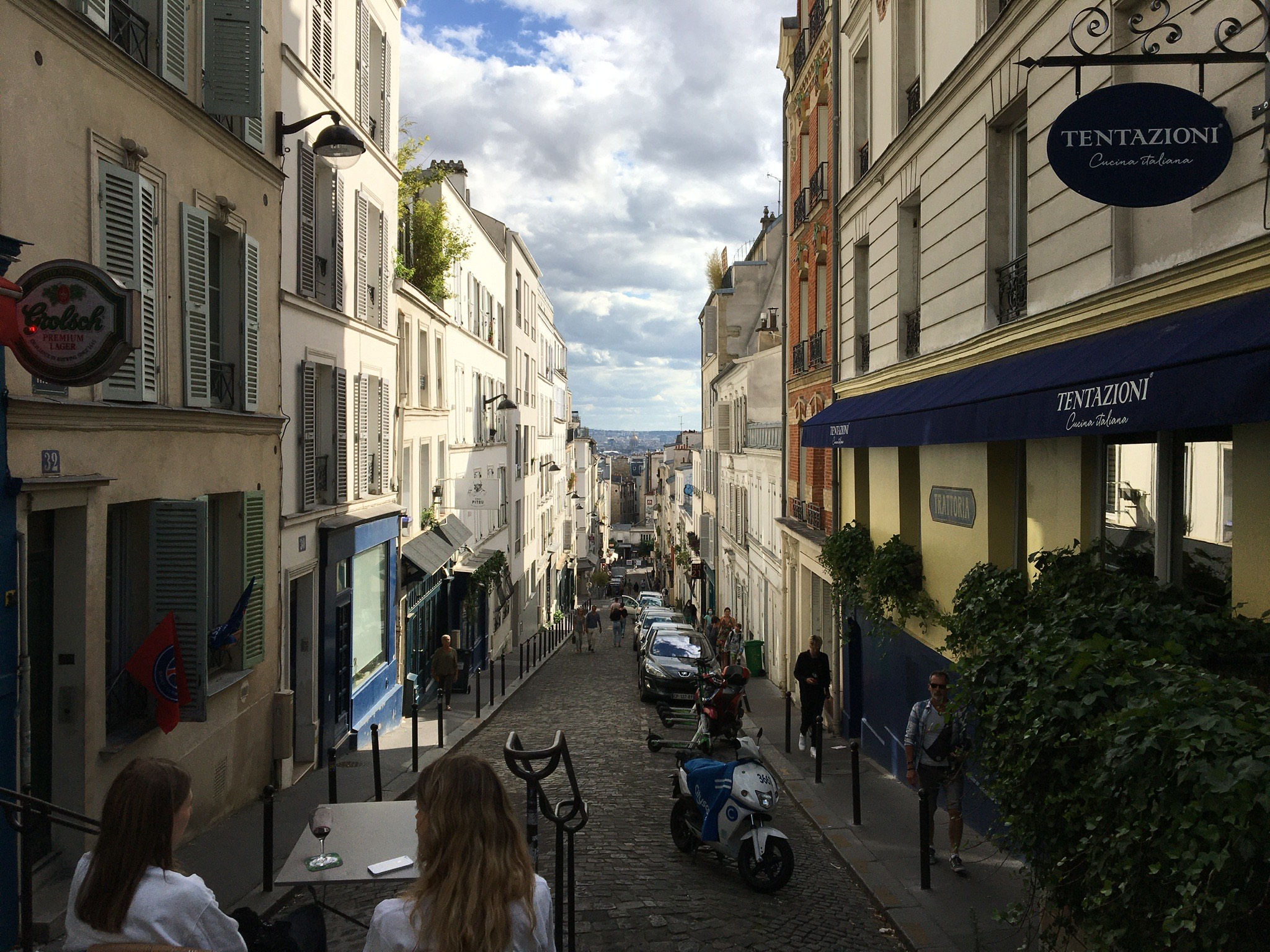
During my previous sojourns in Paris, I lodged in the neighborhood of Cite Universitaire, because the purpose of my stay was research. This time, I stayed in a private home that I found via the website Home Exchange, which allows frequent travellers to swap houses. Spending the entire month of August in the apartment was a novel experience for many different reasons. One was the neighborhood itself, Montmartre, which is on the other side of the city from the one I am very familiar with, and which differs immensely from it. Some streets are almost fully inhabited by recent arrivals from North Africa, and during the hot summer evenings, they would be congregated outside, socializing with each other while speaking boisterously. This created a festive atmosphere that was very different from the more subdued Cite Universitaire, which is mostly inhabited by upper-middle class students from other Western countries (mostly European).


Gare du Nord at sunset. Just around the corner from where I was staying


In Toronto, I live in a one-bedroom condo on the 26th floor; when I open the windows, or sit on the balcony, I hear nothing except the city traffic and the sound of construction machines operating nearby. In Montmartre, I lived on the 4th floor, and hence was much closer—and therefore more connected—to life on the street: sidewalks, passengers, shops and cars. 


When going to bed, I could hear the conversations between drunk patrons in the bar below. In the mornings I would spend many hours in the kitchen, and since I nor my neighbours had air conditioning, our windows were always open, allowing me to hear the sounds emanating from their apartments. From one there was classical music always playing, seemingly from a scratchy record, but more likely from an old CD player. From another the clinking and clacking of pots and pans. Over here, the banal daily conversations between a mother and her daughter; over there, the soft and slow vibration of light snoring. I imagined, meanwhile, that they could hear my noises: typing on my laptop, or speaking loudly with my mom on Messenger, or turning the pages of one of my favourite French magazines, Le Monde Diplomatique. This was a radical contrast from my Toronto apartment, where, due to the thick walls which separate the units, and because windows are always closed for climate control, I never hear a peep from my neighbours, nor they from me. 


The splendour of Montmartre 

Recurring sounds throughout the day in Montmartre are church bells and police and ambulance sirens. The sound of one and the other would often occur simultaneously, and I could not help but notice the poetry of their proximity. Both sounds, in their own ways, signify vulnerability, the fragility of existence, and comfort or protection offered by other members of society when we are in danger. Both were heard frequently, alone or together, throughout the pandemic, and consequently I could not help thinking that they were connected to the virus. Were emergency crews responding to calls about respiratory distress? And were the churches reminding people about how this invisible pathogen was what stood between them and eternity, and that therefore they needed to make peace with themselves and others?


When I arrived in Paris, the daily infections were rising but still contained. By the end of my stay, there was already what seemed to be a second wave, with around six or seven thousand confirmed infections per day, that is, roughly the amount when the decision to lockdown the country was made. Every week, new restrictions were announced: masks were first obligatory in the metro, then in all closed public spaces, then in all shops, stores, and offices, and then outdoors. This did not seem to stem the rise in infections, and for many, including myself, this induced heightened anxiety. I wore a mask everywhere, frequently disinfected my hands, and avoided crowded spaces, particularly public transit. When visiting friends, we maintained physical distancing. I spent a lot of time in Pompidou library, where I was able to read books on French colonial history, and there, rigid rules were in place: to use the library, an online reservation had to be made, which would allow contact tracing in the event of an outbreak; numbers were limited to allow space for physical distancing; eating or taking a coffee break was prohibited, even in the library’s cafeteria, which was in any event closed; masks had to be worn at all times, in a way that covered both the nose and the mouth, and staff frequently walked around to ensure that recalcitrant clients followed this rule. 


Studying at Pompidou library during the pandemic


One notable aspect of the trip was that there were relatively few tourists on the streets. In the past, when walking around Paris, I was struck by how crowded the sidewalks, cafes, and restaurants are with foreigners. Of course, this should not be surprising, since Paris is an international city and a major tourist destination, but still: during previous visits, when strolling on a sidewalk one often heard people speaking only English. During the pandemic, when walking around the city, 95% of the time, I heard French. Tourism has plummeted everywhere, including in Paris, and perhaps for the first time in decades, the city was peopled almost exclusively by Francophones. Admittedly, this was one of the more enjoyable aspects of the trip. 


When I purchased my ticket in the middle of July, my return was slated for September 9th, partly because I planned on visiting my family in Italy in late August. Due to the worsening state of the Covid-19 in Europe, I could not travel to Italy and have contact with my relatives there, some of whom are aged and vulnerable. For the same reason, I decided to return to Toronto earlier than planned, on August 28th. I was disappointed but it seemed that another lockdown, if only a partial one, might occur because the tightening of restrictions each week was not working as intended. Being in Paris during a lockdown—when all except grocery stores would be closed—was not appealing, nor did I want to risk my flight being cancelled and being stuck in the country. 


When leaving, I was a little sad. I hopped on the RER to take me to the airport before sunrise, and this train only heightened the sombre atmosphere. It was in a state of disrepair, making a vibrating and grinding noise each time it accelerated, and, unlike in the past, station stops were not announced in multiple languages, including French. It was as if the pandemic, and the collapse of tourism, led to a general neglect of public transport—or it could simply mean that I randomly boarded a creaky train that morning.


Air France flight from Paris was almost empty

I suspected that the plane would not be full, but I did not expect to find only a third of seats occupied. Almost all the seats behind me were empty, and those in front were not even half filled. This created more comfort and better service for those flying in economy class, but it also added to the general pessimism, since the industry cannot survive if folks don’t travel. My arrival at Pearson International Airport also was not encouraging: it was empty, with only one border agent checking passports for Canadians, and this time, rather than asking questions about my purchases or the purpose of travel, they reminded me about the obligatory 14-day quarantine and inquired whether anyone could do my grocery shopping. I replied yes, my mom, and took public transit home. After I arrived, I started unpacking my luggage, and when my mom dropped off my groceries on the main floor, I went downstairs to pick them up. When going back into the lobby to return to my condo unit, I was aghast to discover that the elevators were not working. I waited 90 minutes for the repairmen to arrive, to no avail. I was jet-lagged and needed to empty my luggage, and did not want to risk waiting in the lobby the entire evening. I therefore took the stairs—all 26 floors—while carrying about 40 pounds of groceries plus a pot of fresh tomato sauce my mom had prepared for me.


It was not a very auspicious return to Toronto. But it was good to be back.


Review of Victor Hugo's "Les Miserables"

Les Miserables is the third novel by Victor Hugo that I have read. The other two—Hunchback of Notre Dame, and Toilers of the Sea—are masterpieces of prose and verse (my analysis of each can be found here and here). I therefore had high expectations when deciding to read Hugo’s Magnus Opus, and they were not disappointed. Les Miserables is 1200 pages, but the commitment required to savour the entirety of this text is worth it, in part because of the sheer aesthetic pleasure, but also because of how enriching it is. The novel tells a gripping story about unmerited suffering, redemption, transformation, and the triumph of love, but it is also an historical and sociological analysis of early 19thcentury France, when the country was experiencing the political convulsions of the revolution, the Napoleonic wars, and the Bourbon restoration. These political events impacted all areas of life, including the most intimate relations, a phenomenon reflected in the novel’s main characters, whose lives are weaved together with Hugo’s characteristic style of writing—poetic, rhythmic, a bit flowery, but nonetheless beautiful and emotionally satiating. 


While narrating the story, and connecting it to French history, Hugo treats readers to an optimistic political philosophy which can be summed up as a celebration of the eponymous miserables, by which he means the lower orders—masses, outcasts, and impoverished. They—not the aristocracy nor the wealthy—are the embodiment of truth and the movers of the history, says Hugo in Les Miserables. Another crucial theme is the constant struggle between idealism, of which the excluded are the vehicle, and the forces of law and stability, which are avidly defended by the privileged even when they stray from what is objectively just. In this cosmic and Manichean clash between good and evil, says Hugo, the former is destined to prevail, and this remains the case even in the face of struggle, tragedy, and loss. 


The Pervasiveness of Evil


The main character of Les Miserables is Jean Valjean. He was born into an impoverished family, and both of his parents died when he was young. One of his sisters, also poor, has seven children, and Jean must earn money at an early age to help support them. While other youngsters are attending their lessons, Jean is working for peanuts as a tree pruner, which helps to purchase the bare necessities for his nieces and nephews. Under these conditions, before the existence of social services to prevent penury, unexpected circumstances could literally mean starvation for people in Jean’s position. And this is exactly what transpires: a bad harvest one year—a not uncommon occurrence—leads to his unemployment. He has no income, which means starvation for him and his sister’s children. One evening, he steals a stale loaf of bread, one that, in any event, would have been thrown out shortly after. He gets caught and is sentenced to five years in prison, which was the actual penalty for minor theft in early 19th century France. 


From here, a terrible odyssey ensues. The penal system was inhumane even by standards of the period, and Jean, who was by no means a criminal, is forced to live in close quarters with genuinely evil men—murderers, rapists, and psychopaths. He also must do forced labour with other inmates while being chained to them and treated like a beast by the prison guards. Jean, unsurprisingly, tries to escape several times, and is caught, leading to more sentences, receiving a total of 19 years. During his long incarceration, he becomes literate; but given the pervasive injustices in his life, knowledge and reason only deepen his ability to understand them and hardens his hatred for everything and everyone. 


At the end of his sentence, he is released, but has the stigma of being a felon, which, in early 19th century France, was the equivalent of leprosy, evoking disgust, fear, contempt, and social ostracism. In provincial France, the site of the prison and the nearby town, it does not take long for word to get around that a convicted criminal will be released, and that all contact with him should be avoided. Jean enters the town of Digne tired and hungry, after walking 20 miles, and needs a room and board that he can pay for thanks to the little money he earned doing hard labour for almost two decades. But he is rejected everywhere. Consequently, he is forced to sleep outside, and, as if it could things could not get any worse, suddenly it starts pouring rain. He finds shelter in an empty dog kennel, but is disturbed when the canine master of this humble abode discovers the intruder and pushes him out. 


Jean is homeless, hungry, desperate, and socially rejected, despite paying his debt to society for an act that, morally speaking, was not even a crime. This only confirms his deep sense of injury and visceral hatred for a society which treated him badly from the get-go. While strolling through the town, alone and dejected, he sees a bench in front of a church and decides to rest on it. A lady at the church sees his distress, and she recommends that he go across the street to the house of the local Bishop. It turns out that this turn of events was fated to have a striking impact on Jean and the rest of the novel.


The Triumph of Goodness


Bishop Bienvenu, as the locals call him, represents, in word, thought, and action, the highest expression of Christian idealism: self-sacrifice, utter devotion to society’s outcasts, humility, un-attachment to worldly objects, including his own life. His absolute trust in God makes him fearless about encountering danger and death; like many of the religion’s greatest martyrs, he combines extraordinary bravery with humility and commitment. He sleeps with the door unlocked, because, Bishop Bienvenu believes, material objects do not really belong to him and so he did not have the right to exclude others from their use; moreover, locking the door would mean trusting in his own efforts, and not on God, to ensure his security. When Jean knocks on his door, the priest, like the other people in the town, recognizes his condition and status, but no matter; to Jean’s utter amazement, he is welcomed with open arms into the Bishop’s house. During dinner and conversation, Jean, incredulous but in complete sincerity, asks, “how do you know whether or not I killed someone?” and the Bishop replies “that is God’s affair”.


Jean wakes up in the middle of the night, while others in the household, including the Bishop, are sleeping, and he decides to steal some valuable objects before leaving. He has an crowbar in his hand, which could be used as a weapon. The valuables he wants are in the Bishop’s room; Jean silently walks in, and sees the Bishop sleeping peacefully. It occurs to Jean that he could have easily taken him out in one strike. Here, a sense of impending doom arises, and readers feel that the seemingly cruel townspeople were right when they coldly refused to give Jean room and board. But, suddenly, Jean looks at crucifix hanging on the wall directly in front of the Bishop’s bed, which has a kind of majestic glow due the play of shadows and moonlight entering the room. Jean is taken aback by this scene, and decides only to steal valuable silverware. 


He leaves the premises immediately, but shortly after is caught by the police, who find the objects and suspect they belong to the Bishop. They take Jean to the Bishop’s house, and when the latter answers the door, the reader expects him to thank the police for arresting this ungrateful, contemptuous criminal and for returning his valuables. Had this occurred, Jean would have spent the rest of his life in prison, doing hard labour, and living in inhumane conditions. Instead, to the reader’s—and Jean’s—utter amazement, the Bishop says to Jean in front of the authorities: “so here you are! I’m delighted to see you. Had you forgotten that I gave you the candlesticks as well? They’re silver like the rest, and worth 200 hundred francs.” The gendarmes subsequently leave, and when they are alone, the Bishop says “Jean Valjean, my brother, you no longer belong to what is evil but to what is good. I have bought your soul to save it from black thoughts and the spirit of perdition, and I give it to God.” 


Jean was stunned; more importantly, this is the beginning of his own transformation, which would eventually transform the lives of others in the novel. Hugo wants to convey that Bishop Benvenu’s immense power to change the destiny of others came, not from possession of resources, prestige, or influence; rather, it emerged from his living example of courage, forgiveness, humility, and self-denial. By virtue of his actions and by a kind of osmosis, Jean would be transformed into a saint. The change was emotionally painful, and Hugo memorably recounts the internal turmoil he experienced: 


Obscurely he perceived that the priests’ forgiveness was the most formidable assault he had ever sustained; that if he resisted it his heart would be hardened once and for all, and that if he yielded he must renounce the hatred which the acts of men had implanted in him during so many years, and to which he clung. He saw dimly that this time he must either conquer or be conquered, and that the battle was now joined, a momentous and decisive battle between the evil in himself and the goodness in that other man…everything in him had changed. It was no longer in his power to behave as though the bishop had not spoken to him and touched his heart.


While he is walking down the road, in total disarray from the mental turmoil, he encounters a little boy, who drops a coin which lands beside Jean; the latter subsequently accidently steps on it. When the boy asks for his money, Jean is dimly aware of his external surroundings, and does not respond. The boy runs away, scared and crying, and tells others he was robbed by the man who others understood to be Jean Valjean, the recently released convicted felon. This misunderstanding would come back to haunt him. 


Rebirth and Renewal


Jean is quite literally a new man, having turned from being hateful, vengeful, and utterly self-absorbed into a genuinely loving and compassionate person, but because he is a convicted felon, he has to change his identity. He becomes Monsieur Madeleine, and settles in Montreuil. While there, he develops a new, cheaper, and better way of producing glassware, and becomes very wealthy. And yet he lives humbly, in a small abode, without any of the luxuries that his money would permit. His factory provides remunerative employment for locals, and creates revenue which funds public works, while a large portion of his income goes to the sick and indigent. In so doing, he uplifts the entire town, and is soon elected mayor, where he continues his wise and beneficent leadership. This occurs while nobody in the town knows about his past. 


This also entangles him with other important characters of the book, Fantine and the Thenardiers. The former is a single mother to Cossette, and cannot afford to take care of her. Consequently, she leaves Cossette with the Thenardier family (more on them below) while she tries to find work, which she eventually does, at the factory founded by Jean but now managed by someone else. Most of her income goes to the Thenardier family, which uses it for their own children rather than, as promised, for Cossette, who is underfed, underclothed, and underwashed. Fantine loses the job at the factory because of the dispute with the manager, and is now unemployed, forcing her into utter humiliation to earn money to support Cossette (this section of the book evokes horror). One evening, she is assaulted by a passerby and responds violently, and is arrested by Javert. When Jean, or mayor Madeleine, discovers this as well as Fantine’s circumstances, he goes to the police station, and orders Javert to release her. This leads to clash between two archetypes—Javert, for whom authority and order are to be uncritically obeyed—and Jean, who knows how the law can be an instrument of evil, and, unlike Javert, is capable of independent ethical reasoning which allows him to identify the Good independently of legality. 


This clash entangles their fate in ways which would have momentous consequences for both, and hence it is worth elaborating on its broader significance, which, I think, is a major theme of Les Miserables. While Jean embodies goodness and justice, Javert embodies the state. For the latter, what is legal is just, and what is illegal is immoral, while Jean’s experience teaches him otherwise: he spent 19 years doing hard labour, treated like a beast and living under the most humiliating circumstances, because he stole a stale loaf of bread to feed his starving nieces and nephews. And he eventually became good, not because of the law, but because of the saintly example of the Bishop. This personal experience with state-sanctioned injustice, plus his moral transformation due to a serendipitous encounter with Monsieur Bienvenu, gave Jean, among other things, the capacity to independently evaluate peoples’ circumstances. Fantine, Jean knew, was not a criminal. She was a victim of an unjust society, and incarcerating her would have added to the wrongs she suffered. 


In Les Miserables, this clash between what is legal yet immoral, and what is good yet illegal, occurred at the level of the nation as well, and was epitomized by the conflict between monarchy and the democratic ideals of the Revolution. The old regime had legal sanction, but it was also the underwriter of an unjust society. Revolutionary activities, in contrast, were outlawed, but they included the morally just ideals of equality. The most noble revolutionaries often had humble origins and were themselves victims of an unjust political and legal order; accordingly, they were concerned precisely with uplifting persons like Fantine.


In the clash over Fantine, Jean’s will prevails, creating hatred and vengefulness in Javert. He gets his revenge by investigating the saintly mayor Madeleine and discovering his true identity: the convicted felon Jean Viljean, who was also on the run for allegedly stealing the coin of the boy he encountered on the road. Meanwhile, Fantine is ill and dying, and Jean ensures that she has the best medical treatment, while visiting her daily in the hospital. Here he learns about Fantine’s daughter, Cossette, and her tragic circumstances. Fantine’s dying wish was see and embrace Cosette one last time, but this cannot occur, and Jean promises her that Cossette will be cared for, a commitment which was destined to change the direction of his life. At the hospital, while Jean is selflessly attending to Fantine’s final needs, Javert arrives and arrests him, and he must now go back to prison. As if to confirm the wickedness of Javert’s approach to life, the town declines and deteriorates without Jean’s enlightened and beneficent leadership.  


Cossette and Paris


Meanwhile, Cossette is stuck with the evil Thenardiers, where she is mistreated; had she remained, she would inevitably be set on a path of misery and suffering for no fault of her own. Without external intervention, evil would have triumphed, but the state could not fulfill this role. Only Jean could save her, but this depends on his liberty, which would mean escaping from prison. Jean does precisely that, and changes his identity again, and goes to where the Thenardiers live. Here, he sees the story state of Cossette’s condition, and uses his wealth to adopt her, while the evil Thenardiers do their utmost to exploit the situation by demanding as much money as possible. 


Cossette is nine years old, and after many years of abuse in the form of violence, neglect, and material deprivation, is now, for the first time in her life, safe and free. They find a dingy apartment in Paris, where she lives under the comfort and protection of Jean. But their situation is precarious because her well-being depends on Jean’s freedom, which is at risk because Javert is on the hunt for him. At a certain point, Javert discovers where Jean and Cossette live, and they are forced to escape. They find refuge in a convent, and here they are safe; Cossette takes her lessons with the other girls, while being raised to become a nun. Jean is happy with the simplicity and safety at the convent, but he recognizes that it would be ethically questionable to keep Cossette enclosed in the convent for the rest of her life without ever experiencing life outside of it. He must put her needs first, and so decides that they must move out. 


Paris: the city of Love


They take daily strolls in the resplendent Jardin du Luxemburg. It is here that she encounters another important character, Marius, who would entangle her and Jean with Paris’s revolutionary movements. Marius saw Cossette and Jean every day in the Jardin, and when their eyes met, it was love at first sight. His circumstances and character—the secret struggles of chastity, and an overflowing goodwill towards all created things—make him ripe for love. Profound emotions are communicated with each glance, even from a distance, but Marius’s paralyzing fear, and Jean’s presence, inhibit him from approaching Cossette. Jean eventually recognizes what is going on, and fears losing Cossette, and so they stop going to the Jardin. But fate had other ideas, and their paths would cross shortly after because Marius, it turns out, lived in the same building as the Thenardiers, who now lived in Paris where they did n’importe quoi, however unethical, in order to survive.


Their daughter, Eponine, learns about the generous Jean, and his charity towards the unfortunate. She writes him a letter, inviting him over to witness the penury they find themselves in. He and Cossette arrive, and they see the sorry state of the Thenardiers, who are now living under a new identity, making them unrecognizable. Marius is watching through a hole in the wall, and witnesses Jean’s generosity first hand when he gives them his jacket and all the money in his pocket. When they leave, Marius discovers an evil plot: the Thenardiers know Jean is rich, and they hatch a scheme to kidnap him and Cossette while demanding an exorbitant amount of money. Marius goes to the police station to report the conspiracy, and here he encounters Javert, who has no idea that it involves his nemesis Jean. 


As the scheme is being executed, Javert intervenes, and inadvertently prevents Jean’s certain death. This entangles the lives of Jean, Cossette, Marius, Javert, and the Thenardiers, and sets the stage for the most riveting section of the book, namely, the rebellion against the restored Bourbons, which is expressed with Hugo’s characteristic flair while conveying the deeper subtexts of the novel: the goodness of the masses, the clash between idealism and the forces of law and order, and, despite the pervasiveness of tragedy and loss, the unstoppable triumph of truth and justice.


The Revolt


There is an epidemic which is causing death and suffering, and wreaking havoc on the economy, creating a climate of anxiety and anger. The sudden demise of a symbolically important person leads to spontaneous and violent protests against the prevailing unjust order. I am not talking about the year 2020; it is 1832 in Paris, when a Cholera outbreak, and the death of a beloved public figure, lead to angry crowds gathering on the street, and to protests against the authorities (the parallels between the events in Les Miserables, and the Spring and Summer of 2020, are striking). Eventually, these spontaneous protests coagulate into a generalized rebellion against the monarchy—and, by extension, the reigning political order in Europe. It attracts a wide range of citizens, each frustrated for their own reasons—some are unhappy with the mistreatment by authority, others are bored with the tediousness of bourgeoisie life, while many, for intellectual and moral reasons, are willing to fight and die for the egalitarian ideals of the Republic. 


These variegated frustrations, in combination with the combustible elements which characterized Paris at the time—the plague and the economic crisis—are channelled against the same source, namely, the reigning authorities. Barricades are formed across the city, and battles between the revolutionaries and the police ensue. Epic clashes are occurring, and all, in their own way, represent a confrontation between ideals of social justice and the forces of preserving an unjust order. Les Miserables focuses on one barricade in particular: the one built by Marius’s old university pals but which also attracts others, notably Javert, Marius and Jean. 


The latter two are motivated by heartbreak rather than any commitment to revolutionary ideals.  Marius is informed that Jean and Cossette would be moving to England, and so he loses all hope for her and for life itself. Fighting and dying for the ideals of the Republic therefore seems like a good way to escape his emotional pain. Meanwhile, Jean discovered the love letters exchanged between Cossette and Marius, and is devastated because she is the only creature in the world he has ever loved. He also knows that Marius is upset about his plans to take her to England, and will deal with the pain by going to the barricade. In another example of Jean’s selflessness, he goes to save Marius, even though he hates him for taking the heart of his precious Cossette. 


During this final phase of the novel, the main characters, mostly members of the lower classes, are grouped together. Here, the reader learns about the romantic side of the revolution: it brings together very different types who are united by a shared frustration with the prevailing order, and who have found meaning that transcends their individual lives. They are therefore ready to die for their cause, and this motivates great acts of heroism, and a willingness to persevere despite the inevitably of being overpowered by the forces of the status quo. The leader of the barricade, Enjolras, gives the reader a sense of how seductive their ideals are: 


We are moving towards the union of nations and the unity of mankind. What Greece first essayed [i.e. democracy] is worthy to be achieved by France. In terms of policy, there is only once principle, the sovereignty of man over himself, and the sovereignty of me over me is called Liberty. It means, in civic terms, an equal outlet for all talents; in political terms, that all votes will carry the same weight…Citizens, our 19th century is great, but the twentieth will be happy [emphasis his]. Today’s fears will all have been abolished—war and conquest, the clash of armed nations, the course of civilization dependent on royal marriages, the birth of hereditary tyrannies, religions beating their heads together like rams in the wilderness…Brothers, we who die here will die in the radiance of the future. We go to the tomb flooded with the light of dawn.”


Javert is behind the barricade as well, but as a police spy. He is caught by Enjolras and condemned to be executed. At a certain point, Jean must carry out the task, and this would have been an opportunity to enact sweet revenge on Javert for all the misery he caused, in Jean’s and others lives, due to his uncritical and unquestioned obedience to authority. And yet the saintly Jean spares his life. Javert was confronted with absolute goodness precisely the same way that Jean was during his encounter with the Bishop. And Javert, too, experienced the turmoil of internal transformation, but rather than choosing the Good which was induced by Jean, he commits suicide. The lesson, Hugo seems to say, is that saintly persons like the Bishop and Jean can, by the sheer power of example, transform the lives and destinies of others, but those at the receiving end are active agents in the process. When the crucial and life-altering encounter occurs, a choice must be made: continue to accept the comfort and familiarity of one’s previous evil life, or the pain and risk of the new and unfamiliar good one. For Javert, the pain of the second path was unbearable, but because of the fatal encounter, he no longer had the option of returning to the unspoiled first one. Death was the only way out. 


Back to the battle. At a certain point, Marius is mortally wounded, and while others are being slaughtered in the final throes of hand-to-hand combat, Jean lifts Marius on his shoulders, finds a sewer and escapes through the excrement-filled bowels of Paris. He brings Marius to his grandfather’s house, where he recovers. He was unconscious throughout the entire ordeal in the sewers, and has no idea that Jean saved his life and made possible his desire to be with Cossette. Meanwhile, Cossette and Jean visit him frequently as he is convalescing, and the families give them their blessing for marriage. 


Jean confesses his criminal past to Marius, who still has no idea that he owes his life to him. This revelation, plus Marius’s and Cossette’s total absorption with one another, slowly creates distance between them and Jean. The latter’s worst fear of losing Cossette has been realized; he is heartbroken and slowly withdraws from their lives. At this point, Jean is in his early sixties; the loss of the beloved Cossette is overwhelming. He isolates, stops eating, ages rapidly, and becomes ill. As death approaches, he is alone at his humble apartment, and Marius discovers the truth about the saintly character of Jean. He and Cossette rush to his apartment, but it is too late: Jean is on his deathbed. Like other saints, he does not fear death; the spirit of the saintly Bishop Bienvenu is in the room, and Jean will soon be reunited with him. In his final moments, his beloved Cossette and Marius are kneeling and crying at his bedside while he caresses their hair; the fading candlelight, slowly burning on the candlesticks given to Jean by the Bishop, shine their final flickers on the dying man’s face. It is the final scene of the book, and I literally wept when reading it. 


The Triumph of Goodness


Jean was struck down by loss, heartbreak, and death, and there is a sense that it was undeserved. After all, he became a kind of saint who was a blessing in other’s lives. His successful business uplifted Montreuil, his charitable activities helped countless poor people, he saved Cossette from the evil Thenardiers, and saved Marius from an early death. He merited, therefore, a longer happier life, perhaps passing his twilight years tending to his garden while enjoying the company of his grandchildren. 


But the goodness he represents did not die with Jean, just as it did not with the passing of Bishop Bienvenu. The latter set the stage for the rest of the novel by his selfless treatment of Jean, transforming him by the power of his example. And Jean, in turn, continued this triumph of the Good by serving others and by saving Cossette and Marius. This couple, consequently, would continue this legacy via their beneficent contribution to their community and to the larger society. Tragedy, loss, and pain could not arrest the inevitably of what is right. It is precisely the same underlying dynamic, Hugo says in Les Miserables, that operates at the level of the nation. The French revolution would eventually become bloody, and lead to countless deaths; but its ideals of justice ultimately transcended the setbacks, losses, and tragedies placed on the path to its realization. 


The most important vehicles for these transformations, we learn in Les Miserables, were people like Jean, with humble beginnings, the “splendour from below,” as Hugo poetically expresses:


Those bare feet and arms, the rags, the ignorance, the abjection, the dark places, all may be enlisted in the service of the ideal. The common sand that you tread underfoot, let it be cast into the furnace to boil and melt and it will become a crystal as splendid as that through which Galileo and Newton discovered the stars…where history scrutinizes the facts, it often finds greatness hand-in-hand with misery. Athens was a mobocracy, down and outs made Holland, the common people more than once saved Rome, and the rabble followed Jesus


I read Les Miserables while in Paris in the summer of 2020, which greatly enriched completing this masterpiece, in part because of the parallels between the story and my own experiences in the city. The Jardin du Luxemburg—where Jean and Cossette would go for their daily walks, and where the budding of the love story between her and Marius commences—is where I would go frequently to work out using the outdoor exercise equipment, or read a book while sitting under a tree, bathed in a soft and gentle summer breeze. I stayed in an apartment in the neighborhood of Montmartre; Jean travelled through the excrement filled sewers of that area when he saved Marius’s life. The social parallels are even more striking: I was in Paris during the height of Covid-19 pandemic which created economic pain and frustration, and the death of George Floyd sparked protests around the world, including in Paris. In a similar vein, the final sections of Les Miserables are set in 1832, during the deadly Cholera epidemic, which ravaged Paris and created frustrations that sparked the violent clashes between the authorities and those fighting for social justice