In this blog post I’ll review Adults in the Room by former Greek finance minister Yanis
Varoufakis, a much awaited book which recounts his negotiations with Greece’s
creditors in 2015, the period when the common currency was on the precipice of
collapse. The story resonates on a personal level because my doctoral thesis (and
subsequent book) was on the politics of the euro, and one of the chapters is
devoted to Greece. This involved, among other things, travelling to Athens
twice, in 2012 and in 2015, to interview subjects and observe first-hand the
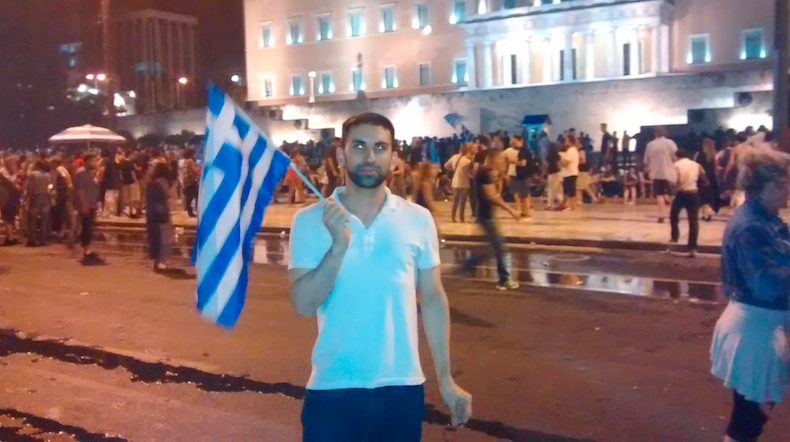
effects of the crisis on people’s lives. When Greece held the historic
referendum on July 5th 2015, and the majority voted No to creditor demands for
more austerity, that evening I participated in the celebrations on Syntagma
square, along with hundreds of thousands of Greeks. It was a triumphal and
euphoric moment that ultimately ended in capitulation and humiliation, which
had repercussions far beyond Greece’s borders. As Varoufakis mentions in Adults in the Room, the humiliation of
Greece contributed to the backlash against Brussels, even among progressives
who previously looked at the EU as a model of peaceful and just international
cooperation. In the UK in particular, many on the left were outraged by the affair,
which influenced their decision to vote for Brexit.
Adults in the Room
provides a behind the scenes, vivid, and riveting account of the struggle
between Greece and its mighty creditors, especially Germany, but what makes
this text really compelling is that it reflects the perspective of an academic
without the pressures faced by politicians. Typically, politicians must be
sensitive to their constituents or the interests of their party, or they must
constantly be on cue and express their ideals or ideological vision; consequently,
their public communication often is characterized with fluff, platitudes, and
shibboleths. One of the marks of a talented scholar, in contrast, is to speak
with clear and honest language, and be willing to defend uncomfortable
arguments regardless of whether they fit contemporary orthodoxies. Varoufakis
accomplishes this in Adults in the Room
by revealing the role of power and hierarchy in the operations of the European
Union, an organization which, according to its promoters, is characterized with
equitable cooperation and partnership. Adults
in the Room shows that, at least in the Eurozone, Germany has near
hegemonic power on the most crucial decisions; even more, the operations of the
Eurozone’s hierarchy resembles, in some ways, colonial practises of yore rather
than the progressive political structure that many imagine it to be.
 |
|
The Road to Greece’s Tragedy
The Great Recession that began in 2007 and spread
around the world had a particularly devastating impact on Eurozone countries,
partly because each no longer had an independent central bank which could
provide liquidity to ailing financial systems or that could devalue the
currency to restore competitiveness. Consequently, the crisis was deeper in the
Eurozone than it was in the US or in European countries without the euro.
Southern Europe was particularly affected, and the impact on Greece was worse
than elsewhere, leading to bankruptcy and the need for a bailout to avert collapse.
In return for funds, Greece’s political establishment agreed to implement reforms,
such as liberalizing labour markets and privatizations, as well as austerity,
namely cutting spending and raising taxes. The IMF, which was and is party to
the bailouts, estimated that these reforms would induce a brief contraction
before spurring growth; what actually occurred was an economic depression which
impoverished and devastated millions, as indicated by the following numbers: six
years of continuous recession, a 28% drop in nominal GDP, unemployment rates
that reached 28% for the general population and an astonishing 65% for youth.
Not only were the bailouts a failure of historic
proportions; their main purpose was not to save Greece but rather to save French
and German banks which made irresponsible loans to Greece during its
credit-fueled economic boom. Another important but less discussed element in
this story is how humiliating the bailouts were; implementing them meant
foreign technocrats (or the “Troika”) coming to Athens and dictating
legislation which reflected the will of creditors rather than Greece’s elected
representatives. Consequently, ministers and deputies reported and were
accountable to the Troika rather than the Parliament or the people.
It was in this context of failed bailouts and the
humiliating way they were implemented that Greece’s politics took a radical and
understandable turn away from the establishment parties and towards the
extremes. The Party of the Radical Left (Syriza) went from being a marginal group
with less than 5% support to winning a plurality of votes in the 2014 election.
This did not reflect a radical change of ideology among millions of Greeks;
many social democrats, independents and conservatives also voted for Syriza
because a key part of its platform was to confront and challenge creditors
rather than obsequiously defer to their authority, as previous governments had
done. These events also cleared the pathway for Varoufakis’ rise to power which,
he says, he never sought. He had a comfortable academic post at the University
of Austin in Texas, and produced, among other things, academically rigorous
accounts of the Eurozone crisis along with proposals to escape it. This
intellectual pedigree, plus his polished English and independence from Greece’s
establishment, meant he possessed the qualities to negotiate with creditors on
Greece’s behalf and as a representative of the Syriza government. Varoufakis
had a moderating effect on the party; the most radical members of Syriza wanted
outright default and exit from the Eurozone. A condition of Varoufakis’s
participation was to expunge unilateral default and Grexit from the
government’s agenda. His proposals included debt-swaps that avoided default but
extended payments to the indefinite future while making them conditional on GDP
growth; tax-cuts and spending increases to stimulate macro-economic demand;
reforms to reduce tax evasion and increase the general efficiency of the Greek
state; and, importantly, an end to the humiliating practice of foreign
technocrats dictating creditors’ will on a supposedly sovereign state’s
legislators and ministry officials.
 |
| A brief moment of triumph on Syntagma Square, July 5th, 2015 |
Most impartial observers, especially American and
British economists, recognized these proposals as quite reasonable and as
providing the debt-stricken country a decent shot at reversing the depression
while remaining a member of the common currency. But creditors were not
interested in negotiating. Varoufakis was prepared for this eventuality, which
is why his program included the creation of a euro-denominated parallel banking
system. In the event of creditors’ intransigence, the ECB would have the power
to starve the Greek banking system, while creditors could terminate payments
that kept the Greek state afloat. Without these funds, all transactions would
cease, leading to collapse and barter. Hence the need for a Plan B of a
parallel system of payments that would allow economic activity to continue. According
to Varoufakis, it would be denominated in euros, but at the click of a button,
the system of payments could be transformed to the drachma. This would mean
Grexit, but Varoufakis clearly states that this nuclear option would most
likely not be used. He expresses the belief that creditors would want to avoid
Grexit because it would mean their loans would never be repaid.
The purpose of the parallel banking system, then, was to force creditors to
compromise, not to leave the Eurozone.
Adults in the
Room becomes particularly gripping and thrilling when
negotiations begin. The forum where talks occurred was called the Eurogroup;
all members of the euro participated, and decisions were made on the basis of unanimity.
On the surface, there appears to be equality and partnership. But behind
appearances was the reality of German dominance in the form of its consent
being a sine qua non for any major
decision. When Varoufakis submitted his ideas, he expected debates about their
merits, and counter-proposals that at least took account of his arguments. Instead,
his ideas were mostly ignored; creditors, led by Germany, inflexibly demanded
that Varoufakis fully implement the bailout conditions agreed by his
predecessors even though they privately
admitted to him that the bailouts were a failure. A striking feature of the
book is the details of the conversations Varoufakis had with important European
statesmen, particularly French finance minister Michel Sapin, Italian finance
minister Carlo Padoan, and European commissioner Pierre Moscovici; they mostly
agreed with his analysis of the crisis and its impact on Greece, and recognized
that more of the same would not be effective. But when they were in Eurogroup
meetings, under the watchful eye of German finance minister Wolfgang Schäuble,
they mostly sang the creditors’ tune.
The same happened when leaders spoke to the press, and
a telling example is the conversation between Varoufakis and Michel Sapin. When
they spoke privately, Sapin agreed with Varoufakis and even suggested he would
challenge creditors during the negotiations. Just moments later, during a press
conference, Sapin expressed the creditors’ narrative that Greece is mostly to
blame, and that it must continue implementing the terms of the bailouts. As they
were walking away, Varoufakis asked his French counterpart why he publicly
expressed beliefs that he personally did not believe, and Sapin replied,
tellingly, “France is not what it used to be”. This comment reveals much about
Europe’s shifting power relations. France historically had a leading role in
the politics of European integration, until German unification. After this event, France and Germany together
took the lead on major decisions, and the reigning assumption was one of
equality between them. Sapin’s fear of openly challenging Germany clearly
reflected France’s subservience.
Events involving another Frenchman, European Commissioner
Pierre Moscovici, also illustrate much about Europe’s hierarchy. The European
Commission represents the ideals and aspirations of Europeanists and
supranationalists because, unlike other institutions, it is supposed to make
decisions on the basis of European rather than national interests. When its
decisions prevail, it suggests that the EU is fulfilling its aspiration of
becoming a truly post-national entity that operates on the basis of common
rather than egoistic concerns; when it is sidelined, it means that national
interests—and hence relative power—determine the outcome. Commission president Moscovici
privately agreed with Varoufakis, and even produced a document that compromised
on some of the creditors’ demands. When this document was shown to Eurogroup
president Jeroen Dijsselbloem, he would not even consider it. The Eurogroup, it
is worth recalling, was the forum which was largely controlled by German finance
minister Wolfgang Schäuble; its unwillingness to even consider the Commission’s
views is further evidence that German hegemony, rather than European ideals,
was the main driver of Eurozone policy.
Challenging Germany
For social contract theorists, hierarchies of all
kinds have a shared feature: one entity commands, and another obeys, and this
occurs even though both parties agree to the arrangement. When hierarchies are
consensual in this way, the stronger party possesses authority. Coercion is used to discipline only when authority is
challenged, and may entail, depending on context, military force or the
imposition of economic distress. This framework helps make sense of some of the
negotiations in the Eurogroup. Germany
does not explicitly command, and its authority is not explicitly recognized.
But in any major decision, it has the
power of veto which others do not; and this veto power is, in effect, a
command. Others in the euro accept its decision partly because they accept
German economic dominance. But when it is challenged, the threat of coercion,
in the form of economic distress, comes into play. This is why the stakes were
so high in Varoufakis’s gamble; he challenged Germany’s authority, and in
response, Germany said: obey, or face Grexit, with all the economic pain that
such an outcome entailed. This asymmetrical capacity to inflict economic pain
almost surely explains France’s and Italy’s unwillingness to challenge Berlin.
All it would take to cause a financial crisis in both countries is for Schäuble
or Merkel to express disapproval or a lack of confidence in their leadership.
Markets would then interpret this as increased economic risk, increasing
interest rates on these highly indebted states, and potentially leading to a
politically destabilizing financial crisis. The reverse would not happen;
markets would largely ignore French and Italian leaders who did not express
confidence in Germany’s economy.
Varoufakis was well aware of how Germany’s will
prevailed over others, which is why he had a plan to create a parallel currency
system in the event that talks broke down; this would have given creditors one
last chance to negotiate, and if they still refused, he would threaten creditors with massive default and, by implication, a return to a national currency. In Adults
in the Room, Varoufakis expresses the belief that this nuclear option would
not actually occur; he was convinced that creditors would compromise as soon as
they realized that default and Grexit were a serious threat.
When he entered the Syriza-led government, he made it
clear that he would not capitulate to creditors, partly because he believed
that unilateral default was less bad than continuing the humiliating and
economically devastating bailouts, but also because he was convinced that
creditors would compromise once they saw that Grexit was imminent. Other
members of the cabinet, including Prime Minister Alexi Tsipras, agreed, and so
initially at least Varoufakis had the backing of the entire government. Those
who followed the events know what eventually transpired: Varoufakis was
sidelined, and Tsipras capitulated to a third bailout with conditions that were
more onerous and humiliating than the previous two.
The reasons for Tsipras’s surrender are complex and
will likely be debated for a long time. Adults
in the Room highlights some of the critical factors and, in the process,
contributes to our understanding of how hierarchy operates in the Eurozone.
Creditors had much sway partly because they could impose economic distress, but
also because they successfully coopted Greece’s domestic oligarchy, comprised
of financial interests, the media establishments funded by wealthy Greek bankers,
and the establishment figures who still held positions of power. Two particular
banks, run by powerful Greek families, profited handsomely from the European
Central Bank’s injection of liquidity into the ailing Greek financial system,
and with the profits they financed media outlets which helped to create panic
and instability during the negotiations between the Syriza team and Greece’s
creditors. Another disgraceful example of successful domestic cooptation is
demonstrated by the actions of Greece’s Central Bank. During the period of Eurogroup
meetings it was led by Governor Stournaras, an establishment-hack who made no
secret of his sympathies for the creditors; Stournaras actively aimed to
undermine the Syriza government by contributing to bank runs, an act which
violated its mandate to be politically neutral. Consequently, negotiations took
place while a state of panic afflicted much of the country, weakening the
Syriza government’s hand.
The cooptation of Greek financial elites effectively
divided and undermined Syriza, ultimately helping to ensure its capitulation
and the continuation of the core’s authority and rule. Here, creditors adopted
the practices used by dominant powers since time immemorial. Previous empires
at least had the virtue of being honest about their activities. In the
Eurozone, in contrast, the tool of cooptation was implemented but beneath the
thin veneer of legality, technocracy, and “partnership”. Other ethically
questionable practices were occurring behind the scenes. When Varoufakis
secured billions of euros in Chinese investment that would have injected a
substantial economic stimulus into Greece, Berlin called Beijing to signal its
displeasure, and the latter decided to reduce its exposure and invest only 100
million euros. In this example, Germany acted to prevent the potential
diminution of its power vis-à-vis Greece by using its influence to stop the
injection of economically stimulating investment from a competing source.
In Adults in the
Room Varoufakis calls these practices neocolonialism. But despite his
recognition of the character of these actions, Varoufakis worked assiduously to
ensure that Greece remained a member of the Eurozone. How can someone who calls
himself progressive want his country to belong to an entity that operates on
the basis of things that progressives detest? Varoufakis provides an answer in
the book that I find to be unconvincing. He says that progressives must try to
transform the euro to make it more socially just, so that it operates on the
basis of equality and democracy rather than the hegemonic control of the strong
over the weak. Varoufakis has even started a new political movement to build
support for this idea across Europe. But this ignores the fundamental reality
that Germany can command partly because it has an asymmetrical capacity to
inflict economic pain; consequently, periphery states must either obey or try
to persuade Germans that they are wrong. The latter is unlikely; most of the
evidence I’ve seen suggests that a majority of Germans agree with the Merkel
government’s position of imposing discipline on Southern Europeans, and
especially Greece. This leaves defiance, which comes with serious potential
costs. If the weaker state is unwilling to risk the costs of the defiance, it
must obey. Varoufakis’s appeal to democratize the Eurozone will not change this
stubborn fact.
In fairness to Varoufakis, there is some evidence that
the costs, economic and political, of defiance would have been considerable for
Greece. Defiance ultimately would have meant returning to the drachma, which
would have halved the value of Greek savings; the new and cheaper currency
would have doubled the costs of imports, such as fuel and medicine. However, although
this likely would have created much economic pain, it would have been
temporary; a new and cheaper currency would also have halved the cost of Greek
exports, immediately increasing competitiveness, which would have induced
sales, investment, and employment. In light of this, I am therefore not
convinced by the establishment narrative that exiting the euro would turn
Greece into a third-world country. The potential political costs, however, are
more difficult to assess and a stronger case can be made that they would have
been devastating. Adults in the Room mentions
an interesting conversation that took place between Varoufakis and Tsipras
shortly after the historic referendum and on the eve of the latter’s
capitulation. Varoufakis sensed that it was coming, which meant that Tsipras
would have betrayed, not only the original agreement of the Syriza cabinet, but
also the 63% of Greeks who had recently voted No to further austerity. During
this conversation, Varoufakis stressed the need to respect the majority’s will
and defy creditors. In response, Tsipras alluded to the possibility of a coup,
and said the president of the country and other elements were ready to take
power. He was referring to the powerful establishment forces, allied with
Eurozone creditors and backed by millions of Greeks who voted Yes in the
referendum, who would be willing to use force to prevent Grexit. Those
favouring Grexit would then have responded with force, raising the prospect of
a civil war and a return to authoritarian rule—a not inconceivable scenario in
light of Greece’s recent history (democracy was established only in 1974 after
a long period of authoritarian rule which was imposed to quash civil conflict
between communists and monarchists).
Adults in the
Room is worth reading even if one does not agree with
Varoufakis. The book is immensely entertaining in part because he is a talented
writer of the events he describes; equally important is that it is written from
the perspective of an academic without the pressures faced by politicians,
which means he can speak honestly and plainly about what actually occurred. The
tale is gripping partly because there is an element of the heroic in the text;
like the Roman senator Cincinnatus who preferred his comfortable life on the
farm but was forced to return to Rome to save the state from civil conflict,
Varoufakis reluctantly left a comfortable academic post to save Greece from its
mighty creditors. Many readers will, like me, probably be tempted cheer for the
underdog and ignore his defects. But an honest appraisal of Varoufakis would
recognize, not only how remarkable his story his, but also his questionable aim
of wanting to remain in a currency system where the dominant state engaged in
profoundly unethical practices to impose its authority.