For years I have had a passion for learning about
antiquity, especially ancient Greece and Rome. During the academic year, it is
hard to indulge in this material because of other commitments. Hence the late summer is when I have the
liberty to read more widely, and one of my goals for August 2017 was to read Edward
Gibbon’s seminal text, The Decline and
Fall of the Roman Empire, before going to Paris on August 24th. It is a
massive tome which requires a huge commitment, and I planned on reading it entirely—around
1400 pages, divided into six volumes. I only partly met my goal and was able to
complete the first two volumes, which together are over 500 pages. The rest of
the book will have to wait for the Christmas break or perhaps the summer of
2018.
Nonetheless, that which I read is astonishing in its
scope, breath, and depth. On its own, the quality of the prose merits attention for
its smooth flow, rich vocabulary, and nuanced expression of the events Gibbon describes. But that will not be the focus in this essay. Rather, I will explore
some of the eerie parallels between ancient Rome and contemporary America, especially
their shared political values, the rise to pre-eminence, and the corruption of
institutions that either cause, or are the effect of, imperial decline. A
separate but important theme of the first two volumes is the Orientalization
and Christianization of Rome, changes that forever altered the moral and
political fabric of the West (and the world). While these internal changes were
happening, Rome was surrounded by barbarians—Germans in the North, Persians in
the East—which ultimately brought down the empire, and this, too, for better
and for worse, permanently and radically changed history. Lastly, The Decline and Fall’s detailed analysis
of various Emperors provides lessons on what constitutes good leadership. Emperor
Julian the Apostate, in particular, displayed the virtues associated with
greatness and which are totally lacking among leaders in the present era.

Rome vs America
Rome began as a small city-state and became master of
the known world, mainly via its conquests of all the territories around the
Mediterranean as well as Britain. Thus the basis of its power was primarily
military; however, its political values also mattered. Unlike Sparta and
Athens, both of which had restrictive citizenship laws that ensured the racial
purity of their peoples, Roman citizenship was open to conquered peoples in
Asia and North Africa, many or most of whom embraced it, sometimes reluctantly,
often enthusiastically, for the prestige that it conferred; Gibbon recounts
how it was not unusual for foreign ambassadors in Rome to abandon their native
land in order to become Roman citizens. Citizenship also offered opportunities
for upward mobility: after becoming citizens, talented and tenacious
individuals could reach the pinnacle of Roman power.
The most significant territorial conquests occurred
when Rome was a republic; at their best, Rome’s republican institutions—Senate,
magistrates, elections, Emperor—worked together, harmoniously and sometimes in
tension, to produce a well-functioning representative political order. As the
empire became wealthy and complex, different factions fought over the spoils,
leading to civil wars and internecine conflict which terminated with the
victory of Octavius (nephew of Julius Caesar). Octavius obtained the title of
Augustus (“Holy One”), as well as dictatorial powers over the Roman world. This event, therefore, also marks the
official end of the Republic. Although republican institutions continued to
operate, they were deprived of much of their authority, and ultimate power over
the fate of entire peoples rested with the emperor and the army. A
concentration of power, unsurprisingly, had a corrosive effect on the polity,
and any story of Rome’s decline must begin here.
In particular, Gibbon recounts how the army became
the supreme institution of Roman sovereignty, and possessed control over who
would become emperor. The armed forces were divided into various orders, and
the most powerful were the Praetorian guards, who controlled, among other
things, the security of the imperial palace and the treasury. If the emperor
denied their requests for, say, better pay, they literally could murder him and
ensure a replacement that was more compliant. A striking example mentioned by
Gibbon is the sorry fate of the emperor Pertinax, who replaced the vain and
corrupt Commodus. After killing Pertinax, the army sold the imperial office to
the highest bidder, and one of Rome’s richest citizens, Didius Julianus,
purchased it. This was a mistake of epic proportions, even by the standards of
the time; not only was Julianus unfit to serve such a complex role, he also had
no control over the armed forces, who ultimately killed him as they did his
predecessors. It was in this context that Alexander Severus, a successful Roman
general of African extraction, entered the scene to save the empire. Severus’s
bravery and military conquests against the Germanic barbarians, and his capacity
and willingness to share the hardships of the meanest soldiers, made him a hero
among his men. When he arrived in the city, his power over the armed forces was
unmatched and he was crowned emperor. Historians are generally fond of Severus;
he tried to correct the abuses of his predecessors, was friendly towards
religious minorities, and redistributed resources to the poor. However, he was a
despot who had no intention of reviving republican institutions. The power of
the military only increased under his tenure, and in this sense he served to
hasten Rome’s decline. Another example of Severus’s contempt of republican
institutions was transferring power to his diabolical son, Caracalla, despite
the latter’s manifest incompetence.
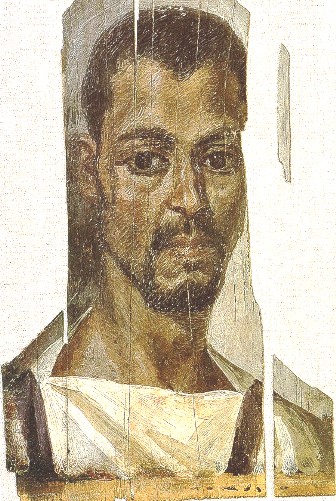 |
| Severus |
One of the key lessons from these events is the fatal
tension between, on the one hand, Empire and the concentration of power and/or
wealth, and on the other republican or democratic institutions. Democracy is
perhaps more manageable and durable in smaller and more homogenous communities
where power and wealth are distributed more equally. As a society’s economic and
political power increases, these goods are unequally distributed, and become
concentrated among specific groups who then have a stake in the perpetuation of
the status quo. Increased wealth, territory, and population also creates more
complexity, and complexity, whether in nature or among humans, creates
pressures for more hierarchical decision making. These two pressures—inequality
and complexity—more and more lead to the concentration of power and hence
decision making in particular institutions or among specific groups of people.
A consequence is that democratic institutions become pantomimes.
We can now begin to see some of the parallels between Rome and America. Both were expressions of political ideals that in many ways were revolutionary. They embraced republican institutions and rejected the system of monarchy which reigned supreme elsewhere. Another was the inclusive, or non-ethnic based, conception of citizenship. Just as peoples all over the world clamour for American citizenship in part because of the prestige associated with it, and in part because of the opportunities it affords, ancients everywhere wanted Roman citizenship for the accrued benefits and status. In both, individuals from marginalized groups could, through talent, effort and tenacity, reach the apex of power. And, of course, both went from being relatively small and homogenous polities to becoming rich and diverse world empires.
A striking similarity is the corrosive effect of
empire on democratic institutions. In 1961, Dwight Eisenhower gave a famous
speech warning of the threat posed by the military industrial complex. Not
coincidentally, this era was America’s golden age, when it enjoyed unmatched
military power as a result of its victory in WW2. This victory, plus the Cold
War, led to the creation of industries with an interest in America’s imperial
governance around the world. And as these industries became larger, they used
their resources to sway the media and representative institutions. Recent
events only prove the perspicacity and prescience of Eisenhower. Some of the
loudest defenders of American intervention are the agencies and groups which
directly benefit from these policies. And, like their Roman ancestors, they
almost always defend their imperialistic policies in the language of universal
justice.
This leads to the obvious question: will America share
Rome’s fate and collapse? The parallels adumbrated above suggests so. But there
are also important differences which should caution against predictions of
America’s inevitable fall. Rome, unlike America, was surrounded by fertile and
warlike barbarians, especially Germans in the North. As Rome’s internal rot
deepened, more and more it became unable to protect itself against Germanic
invasions. In contrast, America is protected by two large oceans that militate
against any foreign invasion, and it shares borders with Mexicans and
Canadians—two very unthreatening peoples. Thus as America’s internal corruption
proceeds, there will be no barbarians to invade Washington to hasten and
complete the final collapse. Much more likely is the continued gradual transfer of
global power to Asia, and especially China, which, short of some cataclysmic
calamity, will continue apace. Another possibility is that some visionary
leader will come to power and reverse America’s decline; but Rome’s example
suggests this is unlikely. As will be expounded below, Rome had several
virtuous and visionary leaders, like Julian the Apostate, who aimed to revive
and re-establish the greatness of their country. But they ultimately failed,
suggesting that, once the rot of inequality and corruption sets in, it cannot
be reversed.
The Transformation of Rome's Civilization
When Rome reached the apex of its power, it was
predominantly a pagan society. One of the immensely valuable aspects of The Decline and Fall is its textured account of
pagan civilization; the book almost transports the reader into the personal world views of Rome’s pagan inhabitants. Pagans could be very tolerant, but not through
conscious effort. Rather, it was because paganism lacked a single and unified
system of rules, beliefs, and texts. Gods were everywhere—from the movement of
celestial bodies, to the operation of human appetites, even within single
households. Thus, unlike their successors, Romans did not believe in the
existence a single religious truth and hence they did not feel a need to
proselytize when Rome conquered a people; a conquered peoples’ gods were
integrated into the fabric of the Roman empire. This produced a kind of
universal religious tolerance, but it was not based in any developed theory
about “rights”; it rather flowed from the largely unquestioned pluralistic metaphysics
of paganism. However, Gibbon reminds the reader that paganism’s tendency
towards religious accommodation coexisted with bizarre and outright cruel
superstitions. One of the tasks of Roman pagan priests was to discern the will
of the gods on major political questions. They did this by interpreting things
like the movements of birds, or the entrails of sacrificed animals. The
decisions of emperors and senators on important questions of state, questions
with life and death implications, would then be influenced by these
interpretations. Another constitutive aspect of Roman-pagan civilization was
the fusion of religious and political institutions; the separation that Western
peoples now take for granted was utterly absent. Thus, for example, the Emperor
was also often the Supreme Pontiff, the latter referring to the office that
governed religious affairs. Pagan Romans did not believe that every human was
created by, and in the image of, a supreme and benevolent God, and hence they
lacked any idea of the existence of universal human dignity that could restrain
human cruelty. Consequently, Roman fathers had the legal authority to murder
their entire families; Roman parents often murdered their own children, mainly
for reasons of poverty; and, of course, Romans enjoyed the spectacle of
watching criminals being torn to pieces by wild beasts in the colosseum.
The orientalization of Rome took two main forms—the importation of
pomp and luxury from the Persian court, and the spread of Eastern religions,
especially Christianity. Here, following Gibbon, I will focus on the latter
because it was much more consequential. In one of the more fascinating parts of
the text, Gibbon explicates how intellectual trends were propitious for the
spread of Christianity. Elite ancient Romans often traveled to Athens and were
schooled in the ideas of classical Greece, especially Aristotle and Plato. A
key metaphysical difference between the two philosophers was whether the most
important element of reality was that which could be perceived directly by the senses, or whether sense perception gave us access to the surface of some
deeper reality only accessible through reason. Plato defended the latter, and
Neo-Platonists in Syria and Egypt endlessly speculated about the nature of this
underlying or hidden reality. For some, it was some sort of non-material
substance, for others, an all-powerful deity.
It goes without saying that the Christian emphasis on an all-powerful
God with generative, creative, and moral force fits better with the
Neoplatonist philosophy, and hence when that religion entered the scene, it
found a ready audience among many pre-eminent philosophers.
Gibbon identifies other causes of Christianity’s
ultimate triumph in the Roman world, but two in particular are worth
discussing: the zeal derived from its Jewish origins and the pure and austere
morals of Christians. Gibbon's account of the ancient Jewish nation is not, to
put it mildly, very flattering to the sensibilities of modern readers. Unlike
other peoples, ancient Jews, Gibbon says, obstinately refused to integrate
into Roman civilization. He also says, compared to other groups in the Roman
empire, they were inclined to fanaticism and insularity. One of Christianity’s
innovations was to create a new religion with a fanatical devotion to a single
and universal truth but without the insularity associated with ancient Judaism.
The Christian message was open to all, regardless of class, race, or any other
arbitrary category. Women were particularly disposed to Christianity because it
imposed monogamy and outlawed homosexuality—meaning that their husbands could
not engage in the common practise among married Roman males to have multiple
partners, including with women and beautiful young boys. Slaves, too, found
Christianity appealing, since it offered them a dignity and elevation that
paganism did not.
A major difference between pagan and Christian worldviews
was that the former emphasized the present while Christians looked forward to
the world to come, which would usher in an era of eternal life and justice to
replace the evils of contemporary society. In practise, this meant that
primitive Christians (i.e., those present from the death of Christ to roughly
the 3rd century AD) did not recognize the supreme value of Roman
power, nor did they participate in Roman social intercourse, meaning they often
neglected to be of civil and military service to the empire. Gibbon makes the
obvious point that this was not conducive to Roman strength; if anything, it
undermined Roman power and introduced an element of weakness: if all Romans
neglected to serve the empire, how could it defend itself against its barbarian
enemies? Accordingly, unlike other religions, Christianity was persecuted by
Roman authorities, and Christians received brutal punishment for their
unwillingness to renounce their faith. This approach backfired. Many pagans
were converted to Christianity because they admired the bravery and the courage
of Christian martyrs who would rather be beheaded or torn to pieces by beasts
in the colosseum than renounce their belief in Christ. Official Roman
persecution of Christians finally ended with the famous Edict of Milan decreed
by Constantine, which gave Christians the liberty to practise and spread their
faith unhindered by Roman authorities. Shortly after, the conversion of the
masses continued apace, but the conversion of Roman elites represented the
irreversible triumph of Christianity. Constantine was Rome’s first Christian
emperor, and as soon as Christianity obtained political power, it went from
being the oppressed group to the oppressor. The Roman Catholic Church was
favoured by the authorities, while pagans were marginalized and persecuted.
Gibbon reminds the reader that we should not exaggerate the extent both of the
pagan persecution of Christians, and the subsequent Christian persecution of
pagans. In the first instance, he calculates that, at most, about 2000
Christians were martyred by Roman authorities, meaning many, many more were
able to continue their devotion unmolested. And Christian authorities preserved
many of the most valuable aspects of classical and pagan civilization,
including Greek philosophy and architecture, demonstrating that they did not aim to completely extinguish the elements of the pre-Christian world.
Lessons on Leadership
The internal and external causes of Rome’s decline were mainly structural, and hence independent of particular
leaders. Yet the quality, or lack thereof, of particular leaders was not
insignificant. Gibbon extensively analyzes all the emperors in the time period
that he covers, and there is insufficient space to mention all of them in this
short essay. Accordingly, I will aim to shorten the list, and impose some
structure by dividing them into three categories: Extremely bad, somewhat bad,
and very good. Doing this allows me to distill lessons from The Decline and Fall on what constitutes
good leadership.
Students of history are very familiar with the roster
of very bad Roman emperors, especially Nero, Caligula, Caracalla, and Commodus.
All were inexperienced and egotistical youths who lacked a mature conception of
the common good to guide major decisions. They detested Rome’s republican
institutions, and exploited the state for personal gain. As Rome burned or was
severely weakened, they surrounded themselves with yes-men who would flatter
their prejudices rather than provide objective and honest advice. Gibbon is
particularly contemptuous of Commodus. According to Gibbon, “every sentiment
of virtue and humanity was extinct in his mind. He valued nothing in sovereign
power, except the unbounded license of indulging his sensual appetites.”
Gibbon adds that “he was the first of Roman emperors totally devoid of taste
for the pleasures of the understanding…from his earliest infancy, he had an
aversion to whatever was rational or liberal and a fond attachment to the
amusements of the populace such as the circus and the combats of gladiators…the
servile crowd whose fortune depended on their master’s vices applauded these
ignoble pursuits.” Imaginative readers of The
Decline and Fall might recognize a parallel between Commodus and Donald
Trump.
Those emperors in the “somewhat bad” category had many
redeeming qualities even if their vices were sufficiently harmful to prevent
them from entering the pantheon of great leaders. They include Aurelian, Alexander
Severus, and Diocletian. All helped to vanquish, at least temporarily, Rome’s
internal and external enemies. They were talented and rose to power through
demonstrated excellence rather than privilege. Severus was North-African and
some surviving images of him suggest that he was non-white, putting a lie to
the notion that Barak Obama was history’s first non-white leader of the world.
Severus demonstrated talent on the battlefield against Germanic barbarians, and
his willingness to share in his soldiers’ hardships during long marches
inspired his men and made him a hero. Nonetheless, as mentioned above, Severus
was a depot who was contemptuous of republican institutions. Gibbon also
devotes much space to Diocletian, who also had humble origins: his parents were
slaves. He rose to prominence because of his successful campaigns against the
Persians, and his conquest of Egypt—Rome’s last major territorial expansion.
Gibbon says that Diocletian “had a vigorous mind, improved by experience and
the study of mankind…he submitted his own passions to the interest of
ambition”. He reigned for 20 years, which in itself is evidence of success when
we consider that many of his predecessors and successors died violently after
very short periods of rule. But Diocletian also is associated with two changes
that hastened or were symptoms of Rome’s decline. One was the orientalization
of the court. When Rome was a republic, it was animated by the values of
humility and equality, even at the highest levels. Emperors, for example, were
considered ministers, and sat with Senators as equals. During this period, it
was not unusual for Roman emperors to mix with the masses and interact with
citizens in a humble manner. Diocletian changed the dress, language, and
comportment of the imperial office. Following Persian practises, he wore sumptuous robes of silk and gold,
had his subjects refer to him as “our Lord”, and required that they fall
prostrate in front of him as a way to express adoration for the divine emperor.
Diocletian also divided the empire into four parts, which ultimately created
the perpetual separation between the Eastern and Western territories.
We now turn to the great leaders, in particular Trajan,
Hadrian, the two Antonines, and Julian the Apostate. All were loved by citizens
and soldiers alike because, in different ways, they displayed the virtues of
bravery, wisdom, humility, the love of learning, discipline, empathy, and
self-negation for the common good. Although they could not prevent Rome’s
decline, they perhaps temporarily reversed or slowed it down. All demonstrated
excellence in their endeavours—whether in the form of enlightened domestic
policy which established the conditions for prosperity, or by defeating or
subduing Rome’s external enemies. Julian the Apostate merits extra attention
because Gibbon analyzes him in a detailed and extensive manner. He was raised
as a Christian, but his independent spirit was not compatible with the complete
devotion and submission associated with early Christianity. At a young age, he
went to Athens, and there, in the Academy, he grew to love the classical
learning and pagan mythology of ancient Greece. Rightly or wrongly, he grew to
believe that the major cause of Rome’s decline was the spread of Christianity,
and hence that the only way to revive the splendor of Rome was to return to the
gods of the Fathers of the Republic. Unsurprisingly, then, Pagans celebrated
his ascension to the throne, while Christians were aghast, and for good reason:
with Julian as emperor, the former could look forward to the return of their
ancient privileges, while Christians dreaded the revival of the persecutions
they had recently experienced.
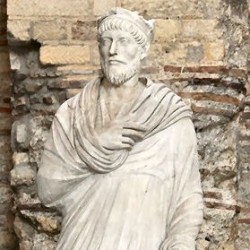 |
| Julian the Apostate |
These biographical features of Julian are interesting but
they are not the source of his greatness. Rather, it was Julian’s many talents
and his complete devotion to the good of Rome even at the cost of his own
comfort and well-being. Julian became emperor not because of personal ambition;
in fact, he likely would have preferred to spend his life in the Academy of
Athens. He was called, as it were, to the office after the death of Constantius
(Constantine’s son) created a vacuum and the need for enlightened leadership to
address Rome’s myriad external and internal problems. The army and the people
selected Julian, and after consulting with the gods, Julian reluctantly
accepted the throne. He endeavoured always to connect authority and virtue, and
was always motivated by the well-being of Rome. When he was not governing, he
devoted himself to the cultivation of his mind through deep, intensive, and
solitary study. He abhorred the oriental despotism introduced by Diocletian,
and refused pompous titles like “Our Lord”. His power and authority gave him
access to all the pleasures and riches of the empire, and yet he was chaste,
slept on the floor, and ate the same foods as the lowest-ranking Roman
soldiers.
Julian displayed that unique and rare combination of
being a brilliant intellectual and possessing the strength, courage, and talent
of an outstanding soldier. When the Persians threatened Rome, Julian marched,
on foot, at the head of the legions, to the front lines to fight them directly
with his men. Reliable accounts attest to Julian’s battlefield valour: he would
charge directly into groups of Persian soldiers, slaying many while dodging arrows.
Tragically but also heroically, Julian met his end while fighting the Persians.
His last words have been recorded for posterity:
“Friends and fellow-soldiers, the seasonable period of
my departure has now arrived, and I discharge, with the cheerfulness of a ready
debtor, the demands of nature...I die without remorse, as I have lived without guilt...Detesting the corrupt and
destructive maxims of despotism, I have considered the happiness of the people
as the end of government. Submitting my actions to the laws of prudence, of
justice, and of moderation, I have trusted the event to the care of providence.
Peace was the object of my councils, as long as peace was consistent with the
public welfare; but when the imperious voice of my country summoned me to arms,
I exposed my person to the dangers of war, with the clear foreknowledge that I
was destined to fall by the sword. I now offer my tribute and gratitude to the
eternal being, who has not suffered me to perish by the cruelty of a tyrant, by
the secret dagger of conspiracy, or by the slow tortures of lingering disease.
He has given me, in the midst of an honourable career, a splendid and glorious
departure from this world; and I hold it equally absurd, equally base, to
solicit or to decline the stroke of fate. This much I have attempted to say;
but my strength fails me, and I feel the approach of death. I shall cautiously
refrain from any word that may tend to influence your suffrages in the election
of an emperor…I shall only, as a good citizen, express my hopes that the Romans
may be blessed with the government of a virtuous sovereign.”
Julian’s extraordinary example suggests timeless
lessons about what constitutes good leadership. His actions and behaviours were
motivated by the singular drive of restoring Roman greatness; indeed, he gave
his own life for this cause. The talents that the gods bestowed on him were not
exercised in the pursuit of personal pleasure, wealth, or power. His conscious
refusal to satisfy his appetites and to instead cultivate virtue in the service
of Rome is indicative of a complete self-negation, or a lack of desire for his
own glory and prestige. His own natural appetites were subsumed to a cause
greater than himself, and his willingness to experience real hardship,
struggle, and ultimately to die for this cause, when instead he could have
chosen not to, suggests a real and genuine commitment. Julian’s example is
striking when comparing him to most of today’s political leaders. They would
never risk their personal wealth, privilege, or safety to a greater cause. Many
of today’s leaders make decisions that have life and death consequences for
others, but they have no skin in the game and hence when things go wrong, they
do not pay any real price. Julian, in contrast, was willing to risk, and
ultimately lost, his life for the greater good of Rome.